A gallery of essays, meditations, and visual stories
Ancient texts, modern intelligence. Ask freely.
10 questions remaining this session
The Road to Emmaus reveals why biblical knowledge fails without divine illumination. Discover how Jesus opens Scripture to reveal himself throughout the Hebrew Bible.
Discover how John's Logos draws from centuries of Jewish Wisdom tradition rather than Greek philosophy, challenging the false corruption vs. purity debate.
Explore John the Baptist's crisis of faith and how Jesus redefined exile, resurrection, and the kingdom of God beyond political liberation to cosmic redemption.
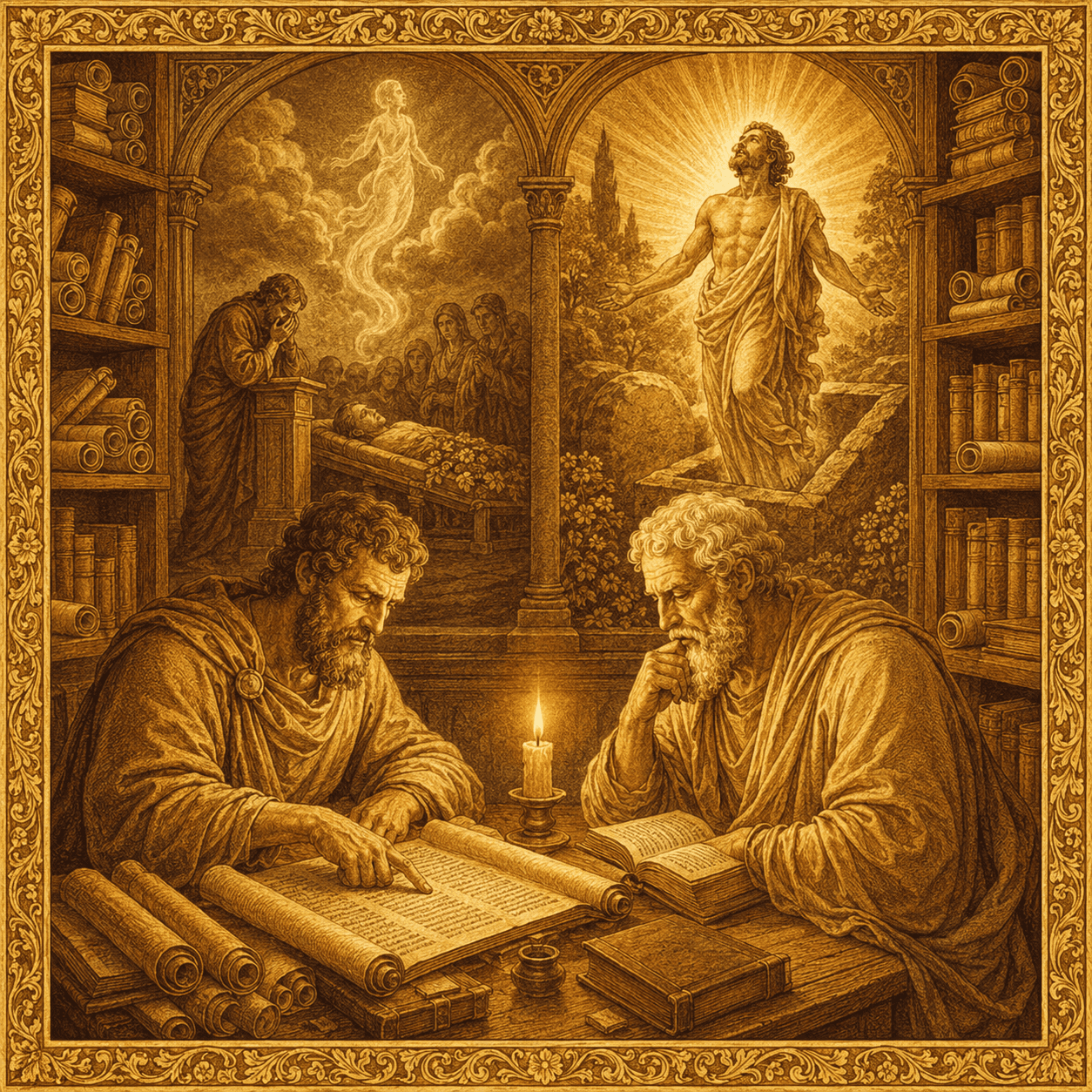
The version of hope we've been sold — souls escaping to heaven — is not the Christian story. The resurrection announces something far more physical, far more radical: God is not abandoning His creation. He is renewing it.
Discover how election theology reframes when we understand God's choice of Abraham as redemptive method, not favoritism—Ancient Near Eastern covenant wisdom explained.
Discover how Second Temple Jewish salvation meant national restoration, not individual heaven-bound souls. Explore the shift from corporate to personal salvation theology.
How the Babylonian Exile created permanent diaspora consciousness that Paul universalized, transforming Christian identity through inherited Jewish displacement theology.
What you worship shapes who you become. The Bible's strangest story explains why, and how to break free.
We are witnessing something far more significant than a policy disagreement. We are witnessing people who have touched upon one of the most vital mysteries of human existence: the fact that we are rarely the neutral observers we imagine ourselves to be.
The startup pitch deck, for all its Silicon Valley novelty, was rehearsing a script as old as human civilization itself — the promise that financial abundance will solve the fundamental problems of human existence.
We live in a curious age where even the most committed materialist treats death as an intruder. The vocabulary of our deepest moral intuitions keeps pointing us toward a story we claim not to believe.
Thomas isn't expressing surprise. He's making a formal, deliberate confession of faith — directing at Jesus the precise vocabulary reserved for YHWH alone. And Jesus accepts it without correction.
When we remake Jesus into a figure who endorses political aggression, who sanctions violence in defense of Christian civilization, we are not recovering some neglected truth. We are committing idolatry.
When Paul encountered a blinding light and a voice from heaven, his scriptural reflexes would have reached for kyrios as the natural way to address the God of Israel. Not because Moses said it that way, but because Paul's Bible taught him to say it that way.
The sheer diversity of religious belief appears to vindicate the relativist position. But the ancient biblical narrative itself predicts precisely this situation—accounting for religious diversity not as evidence against a single divine story, but as the tragic consequence of humanity's repeated attempts to write alternative ones.
The term "antisemitism" depends entirely on the concept of "Semite." And the concept of "Semite" comes from Shem, one of the three sons of Noah. If you reject the biblical story, what exactly are you referring to when you say "antisemitic"? You are using a word without a world.
Names, in the ancient world, were never mere labels. They were prophetic utterances, compressed theology, miniature creeds. This is the story of two names that changed everything: YHWH and Yahusha—and why understanding them reshapes how we read the entire biblical narrative.
Revelation presents us with two concrete destinations—a city and a fire. Life and death. Inclusion and exclusion. Perhaps it is time we took another look.
Reclaiming the Temple We Were Meant to Be — from Eden's garden to the New Jerusalem, God never wanted a building. He wanted a people.
We argue about what we see. We rarely stop to consider how we see it. The frame through which you view reality shapes everything else.
Most people think of heaven as some far-off place where we go after we die. But that was never YHWH's plan. His real plan is much better — He wants heaven and earth to become one place again.
The name "Jesus" is not the name His mother called Him. That name was Yahusha — and unlike a neutral adaptation, this change severed the connection between the Messiah's identity and the very name of the God He came to reveal.
We live in a world fascinated by ancient mysteries. Yet curiously, when the Bible mentions such figures, we often dismiss them as mythology. Take Nimrod, for instance — a figure who connects to some of history's greatest cities and yet remains largely unknown.
Genesis never calls the serpent Satan. The Book of Enoch preserves an older name for Eden's tempter—Gadrel—and it may change how we understand the ancient adversary.
Did the Hebrews borrow their concept of God from the Canaanites? The linguistic, chronological, and theological evidence tells a far more interesting story than simple religious plagiarism.
The first Christians took a word saturated with imperial propaganda and turned it into a declaration that God's kingdom, not Caesar's, is the true good news for the world.
We can go our entire lives breathing without ever thinking about breath itself. And yet breath is perhaps the most profound metaphor the biblical writers had for the presence and power of God. Not because they were looking for poetic flourishes, but because they understood something we've largely forgotten: that every breath is a gift, and the Giver is nearer than we imagine.