There is a scene that plays out, with only minor variations, in funeral homes and graveside services across the Western world. Someone who loved the deceased steps to a podium and says, with genuine tenderness, that their loved one has gone to a better place. Gone home, finally. Free of this broken world. Floating somewhere above the clouds, looking down. The image carries comfort, and one understands why people reach for it. Grief is real, and the longing for something beyond the visible horizon is woven into us.
But here is the problem: that image is not the Christian hope. Not in any form that the writers of the New Testament would have recognized. It is, in fact, something older and far stranger than the Christian message, dressed up in borrowed language and passed off as gospel. To understand why that matters, and why the difference is not merely academic, we need to travel back to the first century and ask what resurrection actually meant to the people who first announced it.
The word is important. When the early followers of Jesus (YHWShA) stood in the streets of Jerusalem and then Rome and Athens and Corinth and declared that God (YHWH) had raised him from the dead, they were not saying that his soul had survived. The ancient world had categories for that. Every Greek-speaking city in the Mediterranean had a vocabulary for the survival of the soul after death. What they lacked, and what the early Christians were insisting had actually happened, was something that struck most educated pagans as frankly absurd: bodily resurrection. Life after life after death. Not escape from the body. Return to it. Transformed, renewed, incorruptible, but physical.
This is where the confusion begins, and it began early.
The Uninvited Guest in Christian Thought
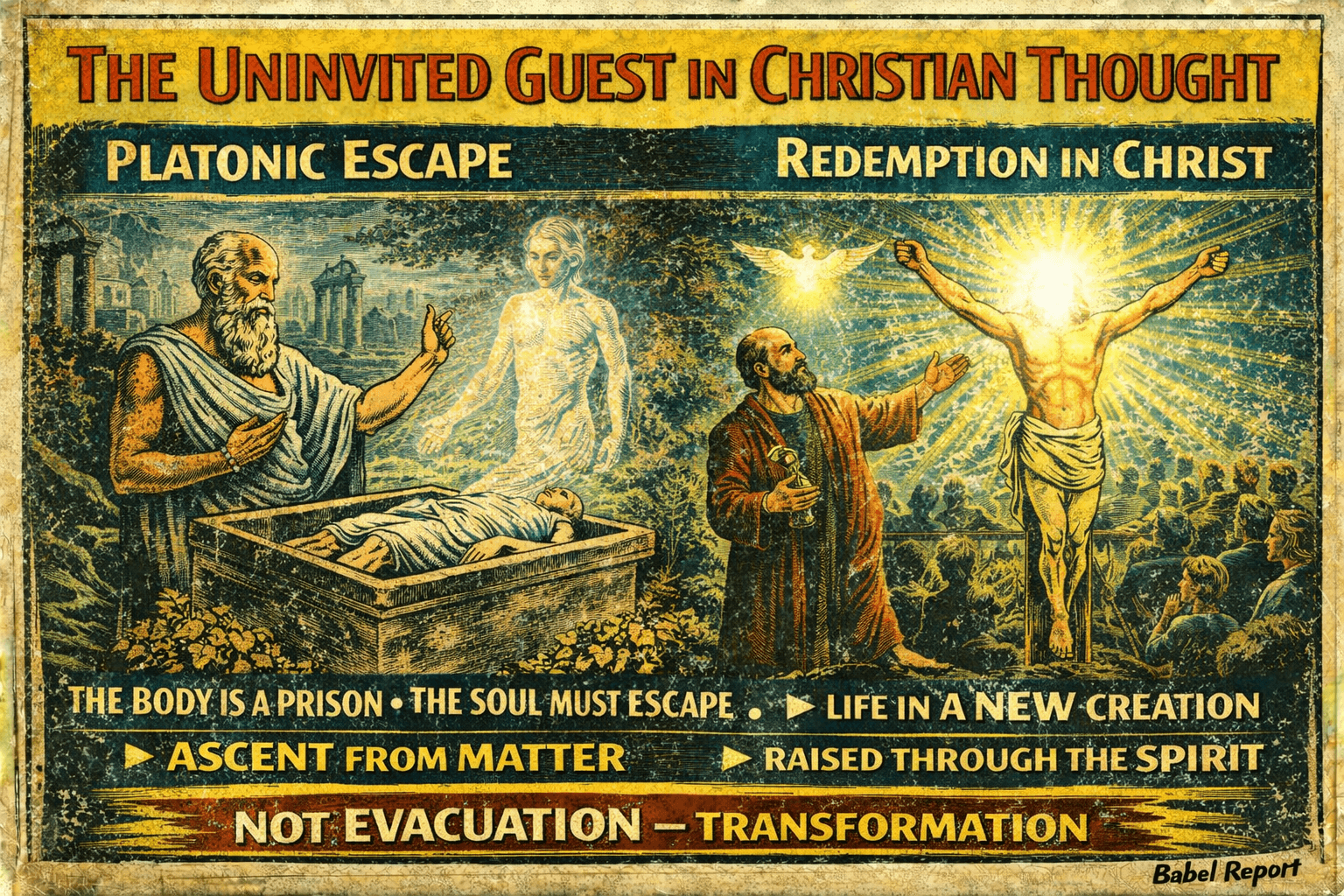
Plato was not a Christian. He never claimed to be. But his ideas got there ahead of many of the church fathers, and they have never entirely left. The Platonic picture of human existence runs something like this: the body is a prison. The soul is the real you, an immortal spark temporarily encased in flesh, and the goal of wisdom is to loosen the soul's attachment to material things so that, at death, it can ascend to the realm of pure being, pure light, pure form. The physical world, in this telling, is at best a shadow of what is real. At worst, it is a trap. The good news, for a Platonist, is escape.
That picture filtered into certain Christian circles very early, and the results have been with us for centuries. Strip out the Platonic furniture and the authentic Christian claim looks startlingly different. The New Testament, from one end to the other, does not announce that God is offering an exit from the physical world. It announces that God is renewing it. Not evacuation. Transformation. The Creator does not abandon creation. He redeems it.
Paul, in the fifteenth chapter of his first letter to the Corinthians, addresses exactly this confusion with more urgency than almost anywhere else in his writing. Some in Corinth had apparently been arguing that there was no future resurrection, and it is not hard to see why. They had heard the word "spiritual" in Paul's teaching and concluded, as many still do today, that the future life would be immaterial, disembodied, ghostly in the best possible sense. Paul corrects this not with irritation but with something more like alarm. The entire chapter is a sustained argument that what God intends is not the abandonment of creation but its renewal. The contrast Paul draws is not between a material body now and a nonmaterial body later. It is between a body animated by the normal frailty of human life and a body animated by the same power that raised Jesus from the dead, imperishable and no longer subject to decay.
The key distinction is not the stuff. It is the source of life.
What the First-Century Jews Actually Believed
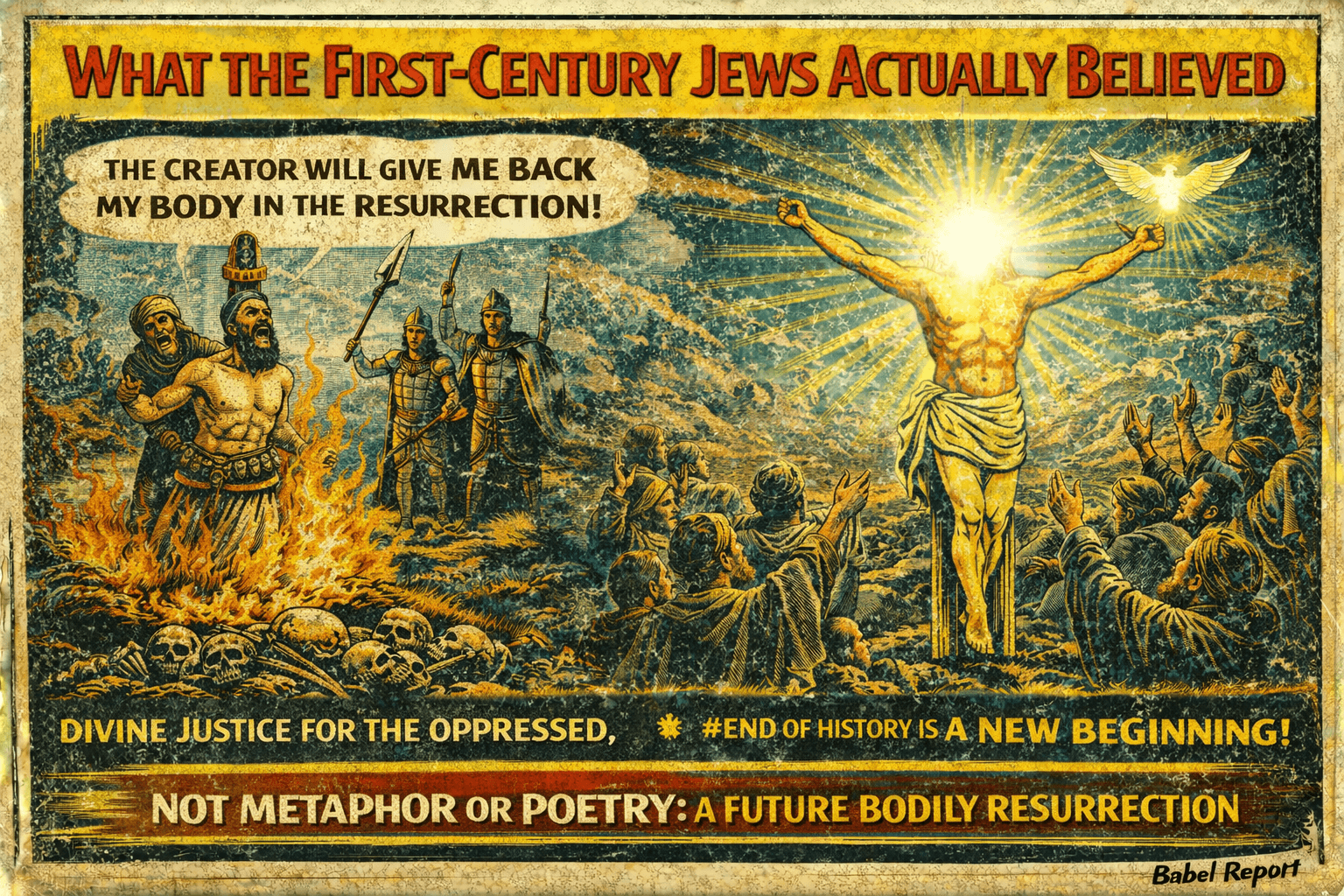
To grasp the full force of what the earliest Christians were saying, it helps to step inside the world they were living in. First-century Judaism was not a monolith, and different groups held genuinely different views about what happened after death. The Sadducees, who controlled the temple establishment, denied any future resurrection altogether, partly for theological reasons and partly because resurrection was, from its earliest forms, a deeply revolutionary doctrine. It promised divine justice for the oppressed. People who benefit from the present arrangement rarely warm to theologies that insist the present arrangement is not the final word.
The Pharisees, and with them the majority of ordinary Jewish people, believed firmly in a future bodily resurrection. When the Maccabean martyrs in the second century before Christ were tortured and killed by pagan rulers for refusing to abandon the Torah, they looked their executioners in the face and promised them that the Creator God would give them their bodies back, their very hands, in the resurrection. That was not metaphor. That was not poetry. It was a defiant, concrete claim about the justice of God.
What resurrection meant in that world was specific: you die, there is an interim state of some kind, and then at the end of history God raises his people bodily to participate in the renewed world he is creating. It was never simply a word for "the soul going to heaven." That meaning had to be imported from somewhere else, and we know where it came from.
Here is what strikes me as most remarkable about this historical picture: no first-century Jew, prior to Easter, expected the resurrection to happen to a single individual in the middle of continuing history. Resurrection was supposed to be a large-scale event at the end of everything, when God brought the long story of his people to its climax. It was not supposed to happen to one man while the rest of history kept going. When the early disciples announced that Jesus had been raised, they were not fitting an event into existing categories. They were announcing something entirely without precedent. And that shock, that unexpected shattering of every prior framework, is precisely what generated the explosive confidence of the early church.
Before We Ask What It Means, We Should Ask Whether It Happened
There is a question that deserves to be addressed head-on before we go any further with the theological implications, and it is a question that a fair number of readers are already sitting with. All of this is very interesting, one might say, but you are building an elaborate structure on a foundation that you have simply assumed. Did any of this actually happen? Was there a tomb? Was it empty? Is there any reason, beyond the testimony of people who already believed, to take any of it seriously?
These are honest questions. They deserve honest engagement.
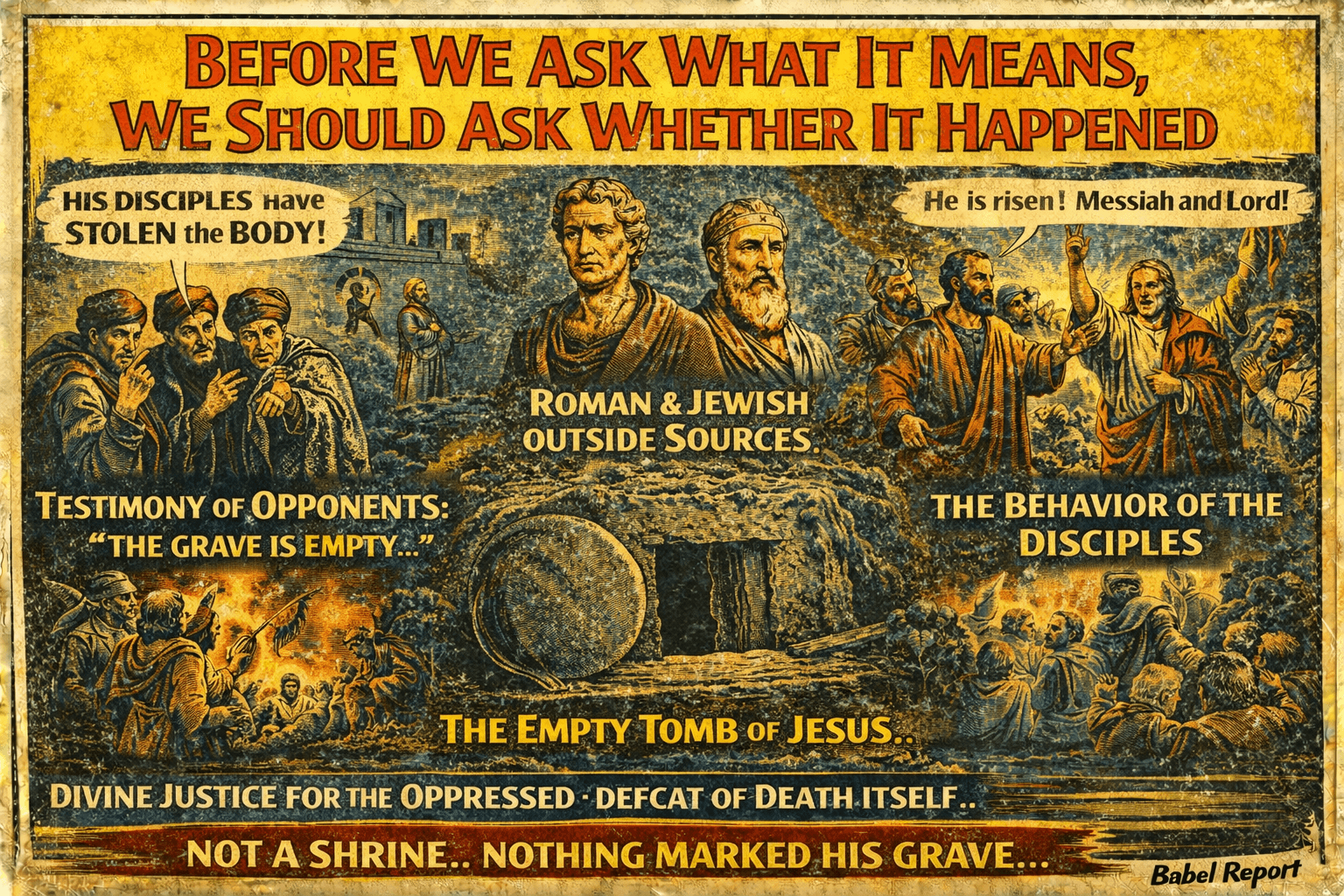
Begin with the testimony of those who most wanted the resurrection to be false. The Jewish authorities in Jerusalem did not respond to the disciples' proclamation by producing a body. They did not open the tomb for public inspection or parade the corpse through the streets to settle the matter. What they circulated instead, according to Matthew's account, was a counter-story: the disciples had crept in during the night and stolen him. Pause on what that counter-story actually concedes. A charge of grave robbery only holds water if the grave is already known to be empty. The opponents of the early movement were not disputing the empty tomb itself. They were offering an alternative explanation for it. That concession, buried inside an accusation, is more significant than it is usually given credit for.
Beyond the internal Christian sources, there are outside voices worth hearing. The Jewish historian Josephus, writing toward the end of the first century, refers in passing to James as the brother of "the one called the Messiah," and records the rapid spread of the movement associated with Jesus of Nazareth. Writing a generation later, the Roman historian Tacitus notes that the Christians took their name from "Christus," executed under Pontius Pilate in the reign of Tiberius, and that the movement had spilled into Rome despite what Tacitus dismissively calls a temporary suppression. Neither man had any reason to promote the Christian cause. Both treat its expansion as a historical reality demanding some account.
Then there is the behavior of the disciples themselves, which is perhaps the most stubborn fact of all. Messianic movements in first-century Palestine were not uncommon. What was uncommon, without a single documented parallel across dozens of such movements, was what the followers of Jesus did after his execution. When a movement's central figure was killed by the authorities, the group either dissolved or regrouped around a new leader, typically a family member. What no one in any other case ever did was announce that the executed leader had risen bodily from the dead and was now Lord over all creation. The disciples had a perfectly positioned candidate in James, the Lord's brother, respected and devout, ready to lead. Instead, with no obvious personal advantage and at clear personal risk, they insisted on a claim that made them targets of both Roman and Jewish power. The psychology of this requires explanation. People do not generally court prison and execution for a fabrication they personally constructed.
One further detail carries weight that is easy to overlook. Ancient Jewish culture maintained a consistent and deep practice of venerating the graves of its prophets, its martyrs, its heroes. Shrines were built at burial sites. Prayers were offered there. Commemorative gatherings were held. There is no evidence of any such practice developing around the tomb of Jesus. Not a trace. In a culture that reliably honored its dead in exactly this way, the complete silence around what should have been a major pilgrimage site points in one direction only. His first followers knew the tomb held nothing worth visiting.
None of this forces a conclusion. Historical argument rarely closes every door. But the weight of these converging facts, considered honestly, is considerable: the empty tomb granted even by opponents, the independent non-Christian witnesses, the otherwise inexplicable transformation of frightened and scattered disciples into people willing to be imprisoned and killed, and the strange emptiness where a martyr's shrine should have stood. Something happened. The question of what is the most important question the first century left for us.
That is the foundation the rest of this argument is standing on.
The Mutation That Changed Everything
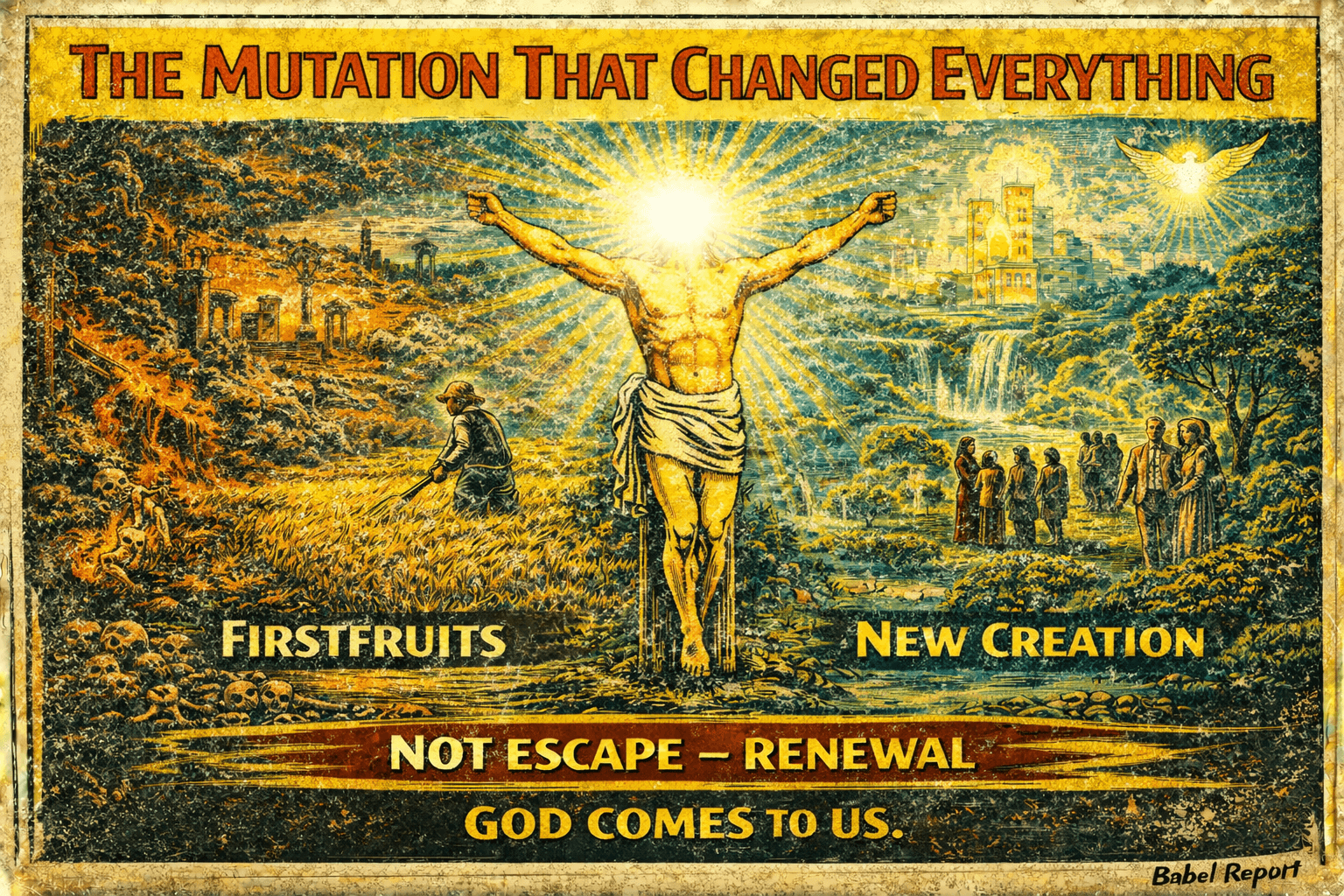
The resurrection of Jesus did not simply confirm what first-century Jews already expected. It altered the framework permanently. The early Christians found themselves working with a picture of history that had split into two phases. The promised end-time event had begun, in one person, ahead of everyone else. Jesus was the firstfruits, as Paul puts it, the first sheaf of a harvest whose rest was still coming. His resurrection was not the whole story. It was the opening chapter of the world's renewal.
This matters because it means the future the New Testament is pointing toward is not a different world that leaves this one behind. It is this world, healed, remade, and filled with the glory of God in a way that the present age cannot contain. The closing chapters of Revelation are not a description of souls in an ethereal heaven. They are a picture of a new heaven and a new earth coming together, of God himself making his dwelling among human beings in a renewed creation. The direction of travel is not up and away. It is down and in. God comes to us.
What we do with that vision determines almost everything else about how we live.
Why the Escape Narrative Is So Costly
One can understand why the escape narrative is appealing. This world contains genuine suffering, genuine injustice, genuine grief. The idea that there is something better waiting, something that leaves all of this behind, carries obvious emotional force. Many devout and sincere people have found comfort in it. That is not nothing.
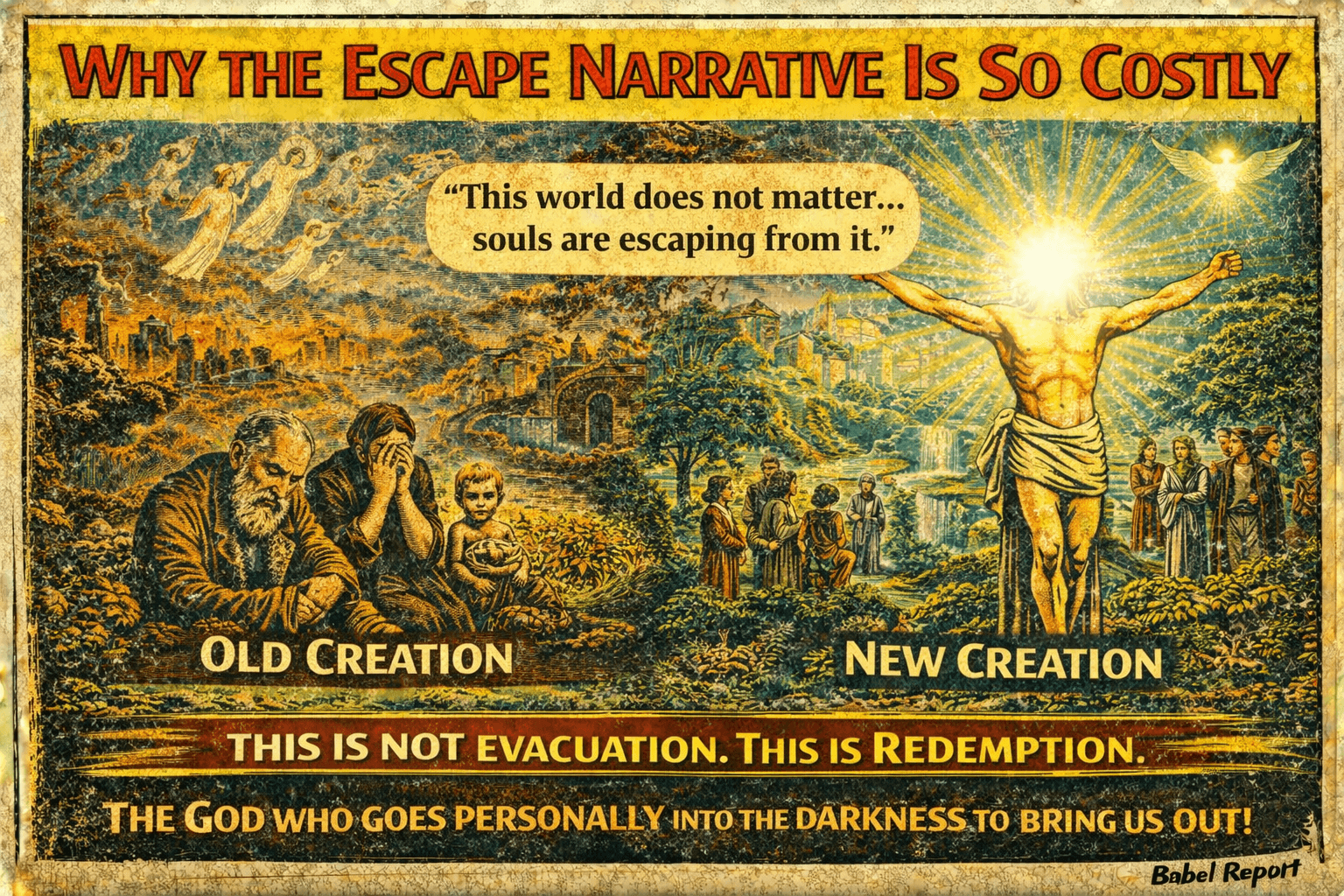
But the cost of the escape narrative is higher than it appears. If the ultimate goal is to leave the physical world behind, then the physical world carries no ultimate value. Bodies become containers, not selves. The earth becomes a waiting room. Work for justice, care for the poor, the healing of communities, the restoration of broken things, all of it becomes, at the deepest level, a way of passing time until the evacuation. Karl Marx was not entirely wrong when he observed that religion had sometimes functioned as an opiate, convincing the oppressed to endure rather than transform. He was wrong about the cause, but he was identifying a real phenomenon. The version of Christianity he was watching had absorbed enough Platonic influence to make peace with the present world by looking past it.
The biblical story does not do that. It insists that the present world matters to God with the intensity of a parent who will not abandon a child, who goes into the darkness personally to bring them out. The cross is not the story of God rescuing souls from bodies. It is the story of the Creator taking the full weight of creation's brokenness into himself, absorbing it, and overcoming it from within. The resurrection is the announcement that this has worked. That the darkness did not win. That the new creation has already begun, in a garden, on a Sunday morning, with a man who ate breakfast and asked a grieving woman why she was weeping.
This is not the message of a God who wants us to float away. This is the message of a God who intends to put everything right.
The Weight of Present Work
Paul concludes the entire fifteenth chapter of 1 Corinthians, after all his careful argument about the nature of the resurrection body and the scope of God's new creation, with a single practical application. It does not say: therefore rest easy, because you are leaving this world soon. It says: therefore be steadfast, immovable, always abounding in the Lord's work, because you know that your labor in the Lord is not in vain.
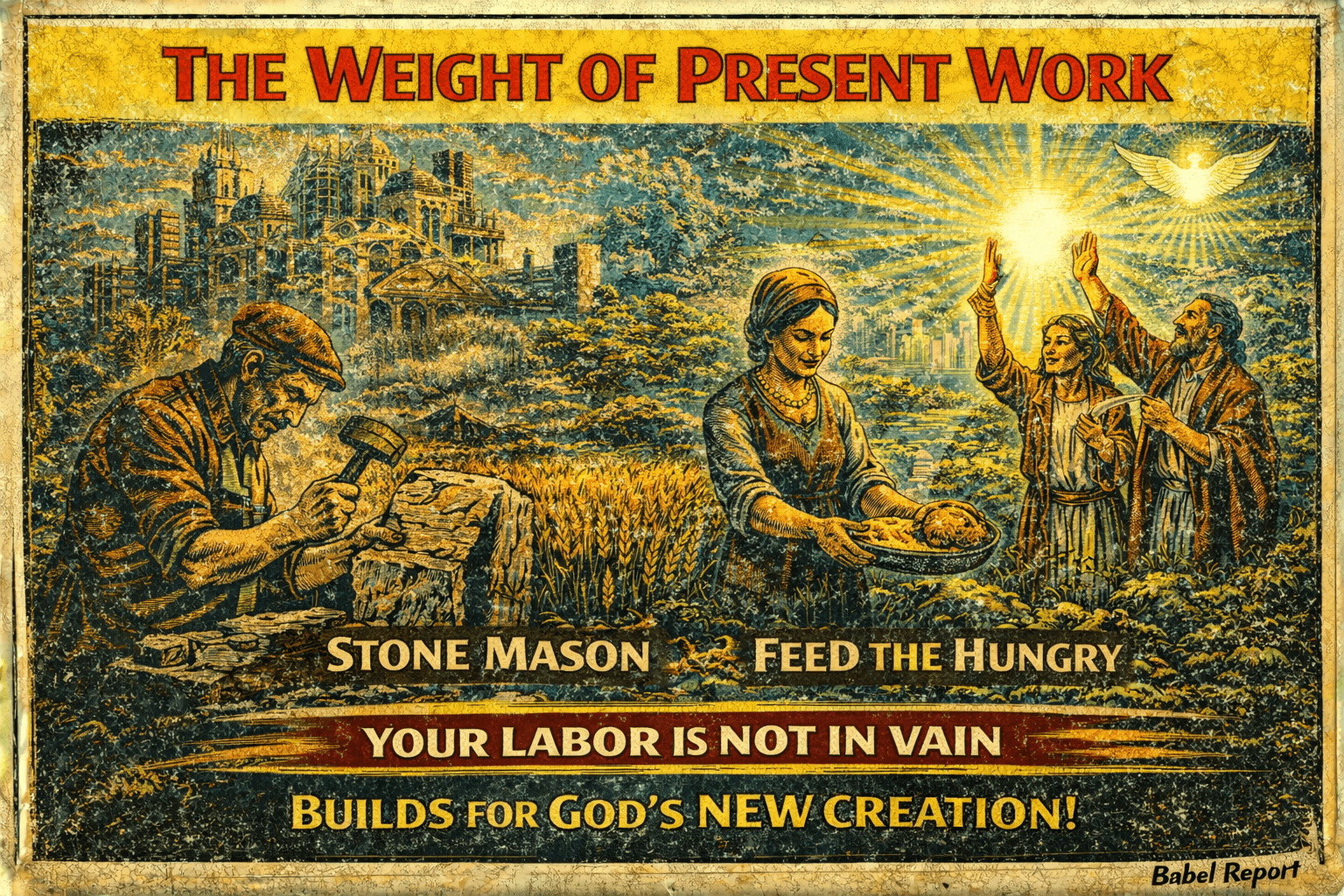
Not in vain. Those three words carry the full weight of the argument. They mean that what you do now, in this body, in this world, with these hands and this mind and these relationships, is not erased by death. It is taken up, somehow, into God's future. The stonemason shaping a piece of carved stone does not know exactly where in the cathedral it will be placed. He may not live to see the building completed. But the stone is not wasted. The architect knows where it goes.
This changes everything about how we inhabit the present. The person who feeds the hungry is not simply alleviating a problem until the real solution arrives. The person who builds something beautiful is not decorating a condemned building. The person who works for justice is not managing a situation that God has already decided to scrap. They are building for the kingdom, participating in the work that the Creator himself has begun and will finish. The present age and the age to come are not separate worlds with no connection. They are, in Paul's language, the present harvest and the new creation it is growing into.
What the Hebrew Story Always Knew
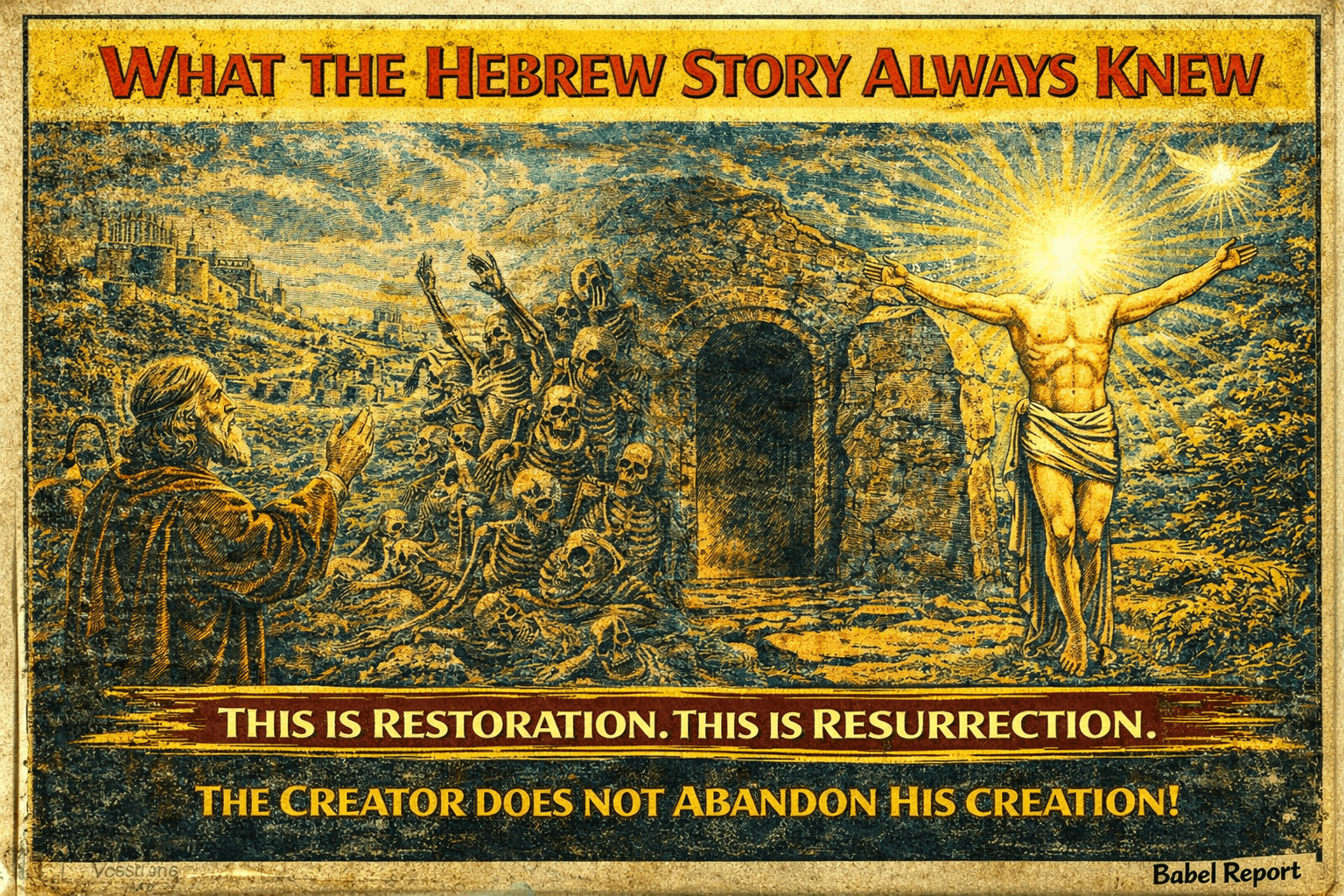
It is worth pausing to observe that none of this would have surprised the authors of the Hebrew scriptures. The Alohim who looked at what he had made and called it good is not a deity who regards the physical world as a regrettable problem. He is the one who, when his people were exiled and broken, spoke through the prophet Ezekiel of dry bones coming to life, of breath returning, of a nation rising from its own grave, not to escape the land but to fill it again. The vision of restoration in the Hebrew prophets is intensely material: vineyards, children, cities rebuilt, the desert blooming. These are not metaphors for souls ascending to heaven. They are promises about what God intends for his world.
The resurrection of Jesus is not a departure from that story. It is the point toward which the whole of it was moving. The one who rose from the dead is the same one through whom, as the opening of John's Gospel insists, all things were made. The Creator does not abandon his creation. He reclaims it.
This is the message that got the early church into trouble with Rome, and it is not difficult to see why. A gospel that told people to endure the present world in hope of escape would have been manageable. A gospel that announced the world's rightful Lord had risen and was coming to remake everything was a direct challenge to every earthly power that had staked its authority on permanence. The resurrection is not a spiritual event with personal implications. It is a public announcement with cosmic consequences.
The Invitation the Story Extends
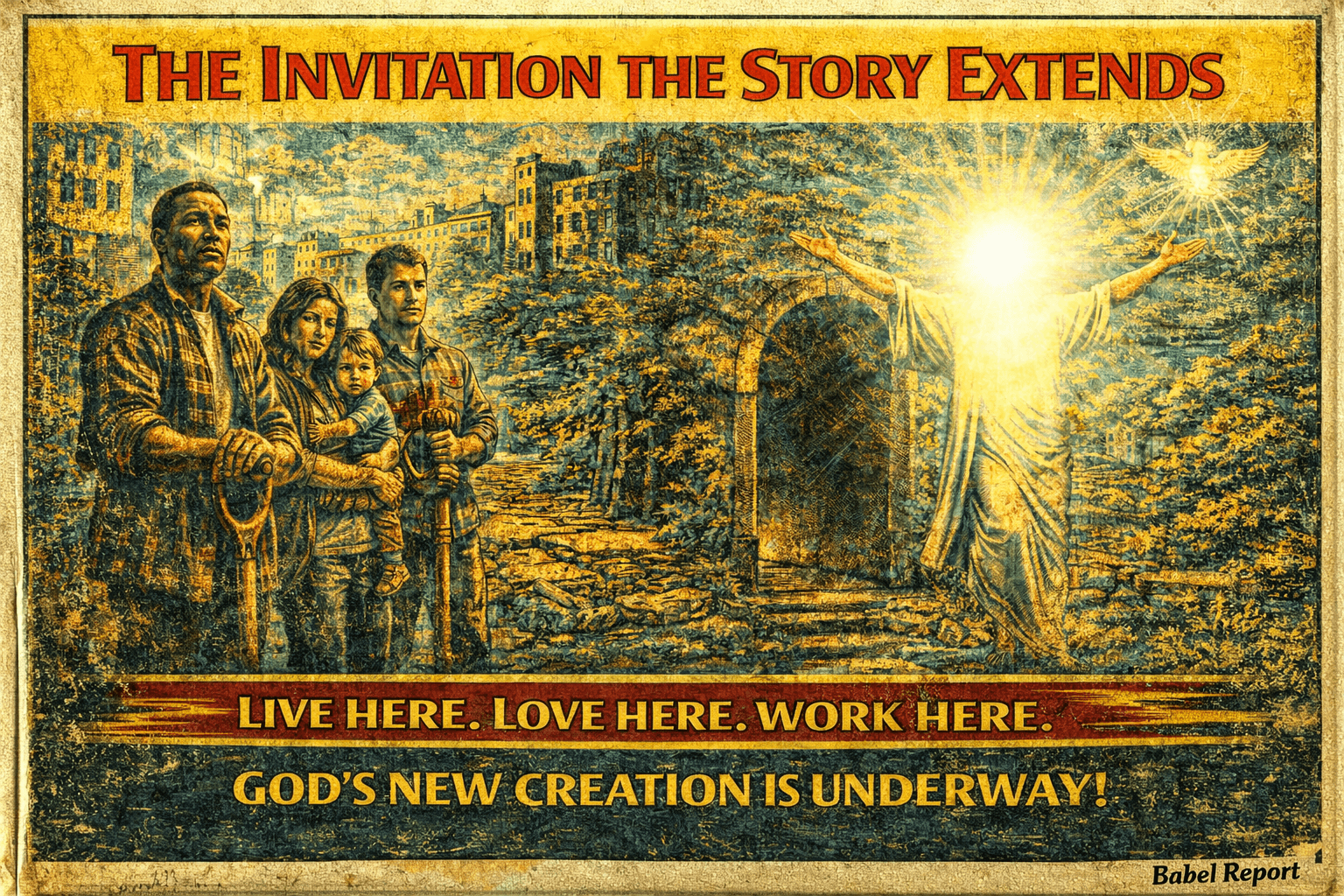
There is, at the end of all this, a question that presses itself on anyone who has followed the argument this far. If the goal is not escape but renewal, if the resurrection means not that the body is discarded but that it is transformed, if the hope of the biblical story is a new creation rather than a different realm, then what does that ask of us now?
It asks something quite concrete. It asks that we take seriously the bodies we have, the neighborhoods we live in, the communities we are part of. It asks that we treat work as potentially sacred rather than merely pragmatic. It asks that we resist the comfortable numbness of a faith that is content to wait for evacuation while the world around it suffers. And it asks that we hold open the possibility that the ancient story, the one the earliest Christians staked their lives on, is actually true in the most physical sense imaginable: that a first-century Jewish man walked out of his tomb, that this event launched God's new creation in the middle of history, and that the whole direction of everything is toward renewal, not escape.
The invitation is not to float away from the world. It is to stand in it, more fully, more hopefully, more deliberately, as people who know that what is done here, done well, done in love, will not ultimately be lost.
The new creation has already begun. The question is whether we will live accordingly.