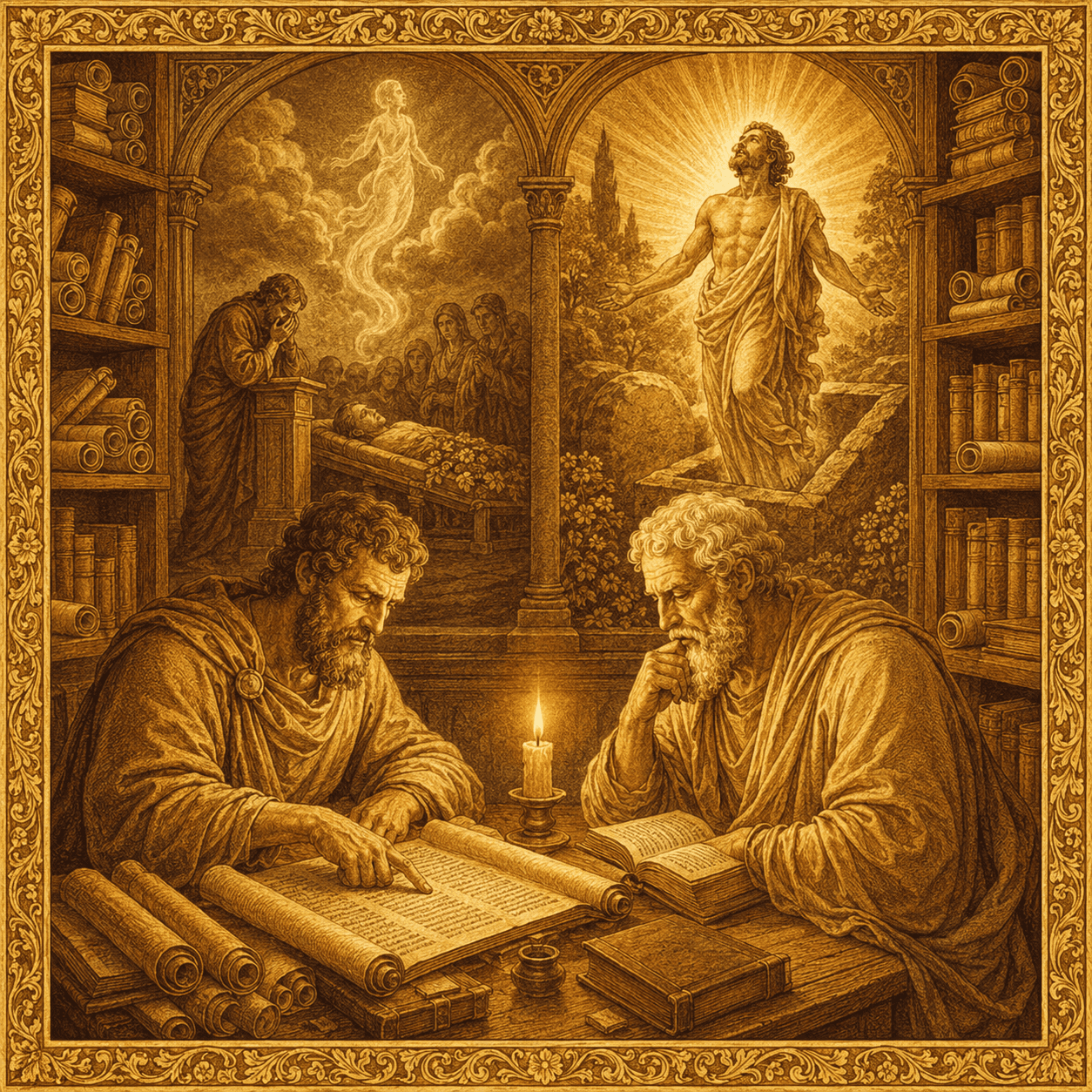
Shaped By Worship
Shaped By Worship
You Become What You Worship: The Watchers, Idolatry, and the Road to New Creation
There is a story most of us were never told. Not because it was hidden away in some dusty vault or locked behind the walls of an ancient monastery, though parts of it were preserved in exactly those kinds of places. We were never told it because, somewhere along the way, we decided the story was too strange, too uncomfortable, too far removed from the sensible world of modern faith and respectable theology. We shelved it. We moved on to safer ground.
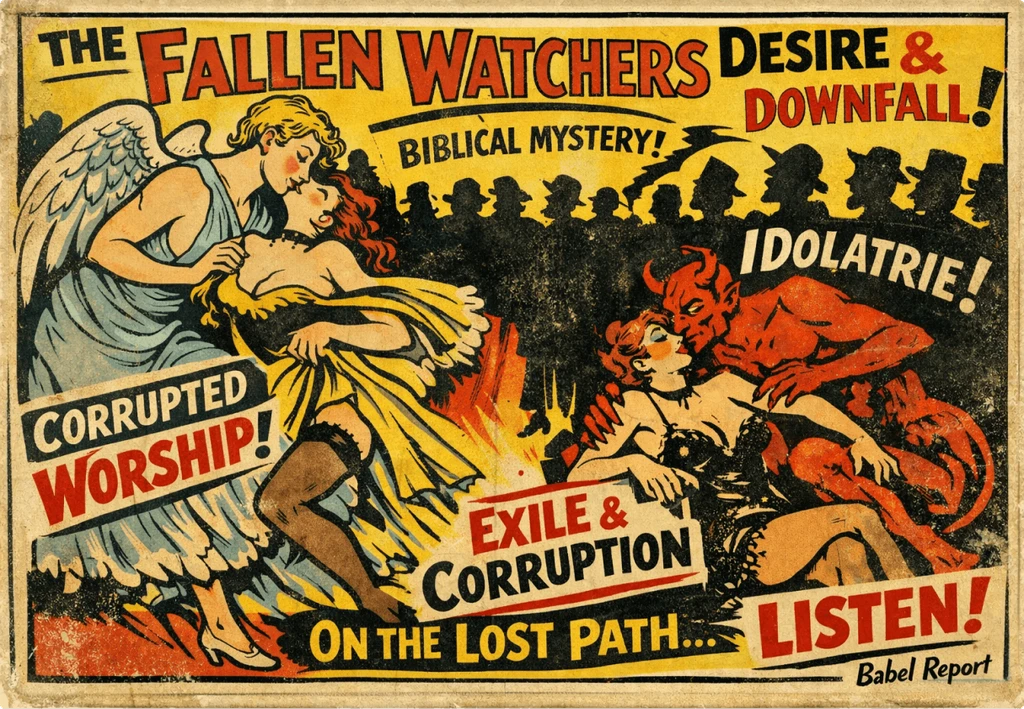
The story concerns a group of heavenly beings who abandoned their post. They were called the Watchers. And what they did, and what followed from what they did, turns out to be one of the most important threads running through the biblical narrative, from Genesis to Jude and beyond. It is a story about desire and disorder, about worship and its corruption, about exile and the long road home. And if we listen carefully, it is a story about us.
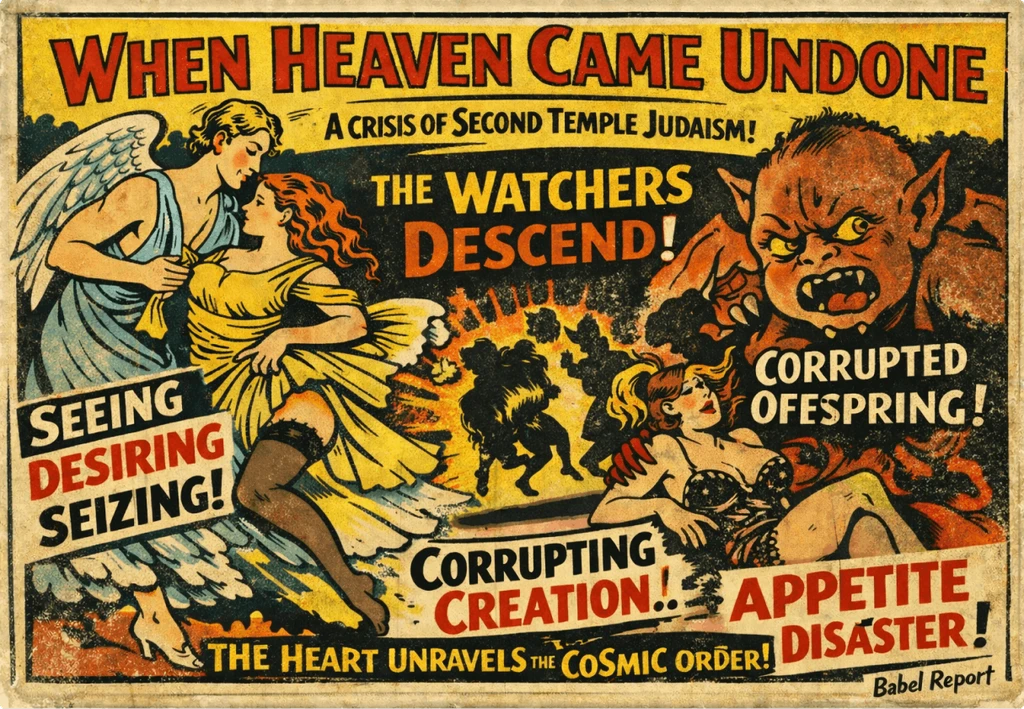
When Heaven Came Undone
We need to transport ourselves back into the world of Second Temple Judaism to understand what is actually happening in the opening verses of Genesis 6. Modern readers tend to skim over these lines with a kind of embarrassed shrug, as if the biblical writers made a mistake they would rather we not examine too closely. The ancient Jewish readers did no such thing. They saw in those verses the hinge upon which the drama of human corruption turns.
The Book of the Watchers, preserved in the collection known as 1 Enoch, tells the story in vivid detail. The "sons of heaven" saw the daughters of men and desired them. They descended from their proper station, took human wives, and produced offspring of monstrous proportion and appetite. The text was widely read in the first century. It shaped how Jews and early Christians understood evil, judgment, and the nature of spiritual rebellion. It was not a curiosity filed under "things we no longer believe." It was part of the air they breathed.
Now, here is what strikes me as most remarkable about this tradition. The motivation for the Watchers' descent was not some grand ideological revolt. It was not a philosophical disagreement with the Almighty. It was desire. They saw, and they wanted. The Testament of Reuben describes them as "filled with desire" and says they "perpetrated the act in their minds" before they ever took physical form to carry it out. The corruption began in the mind. The physical violation of the cosmic order came second.
This echoes something older still. In the Garden, Eve "saw" the fruit and desired it. The pattern is the same: seeing, wanting, seizing. And in both cases, the result is catastrophe. Not because God (YHWH) is petty or vengeful, but because desire, when it overrides the Creator's design, unravels the fabric of creation itself.
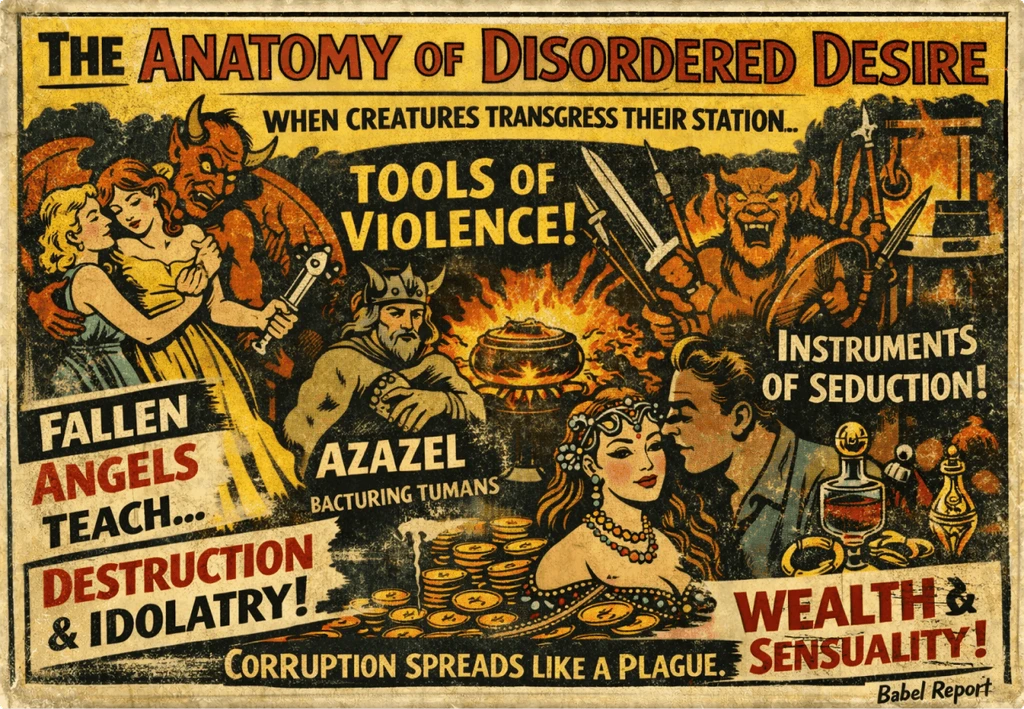
The Anatomy of Disordered Desire
We must be careful here not to reduce this to a simple morality tale about sexual temptation, though that element is certainly present. What the ancient writers are describing is something far more profound. They are describing what happens when any creature, whether angelic or human, refuses to keep the station assigned to it by the Creator. This is what Jude refers to when he speaks of angels who "did not keep to their own domain but deserted their proper dwelling" (Jude 6).
One can understand, perhaps, the instinct to interpret this story as a quaint relic, a piece of ancient mythology best left to specialists and footnotes. And there is a kind of sophistication in that dismissal. But what you cannot do, if you want to remain coherent, is dismiss this story and then wonder why the world feels disordered. The biblical writers are offering an explanation for the chaos. We would do well to listen before we argue.
For a first-century Jew, the "sin" of the Watchers was not merely a private moral failing. It was a form of idolatry. They were spiritual beings who chose to act like "children of earth." God (Alohim) rebukes them in 1 Enoch by pointing out that marriage and reproduction belong to mortal creatures who need them. The Watchers, being immortal, had no such need. They were seizing a mode of existence that did not belong to them. And in doing so, they introduced a corruption that spread through the entire human family like fire through dry timber.
There is another layer here that we ought not to miss. The tradition tells us that the Watchers did not merely take wives. They also taught humanity illicit knowledge. The fallen angel Azazel taught the making of jewelry, cosmetics, and weapons of war. These were viewed not as neutral technologies but as tools of seduction and violence, instruments that would, in turn, inflame the very desires that had brought the Watchers down in the first place. We see here a vicious cycle: the angels surrender to disordered desire, and in doing so they teach humanity how to become more desirable, more violent, more thoroughly corrupted. The ancient writers like Tertullian later picked up on this, arguing that elaborate ornamentation was introduced by the fallen powers to assault human integrity.
That is the nature of idolatry. It does not stay contained. It metastasizes.
Children of the Rebellion
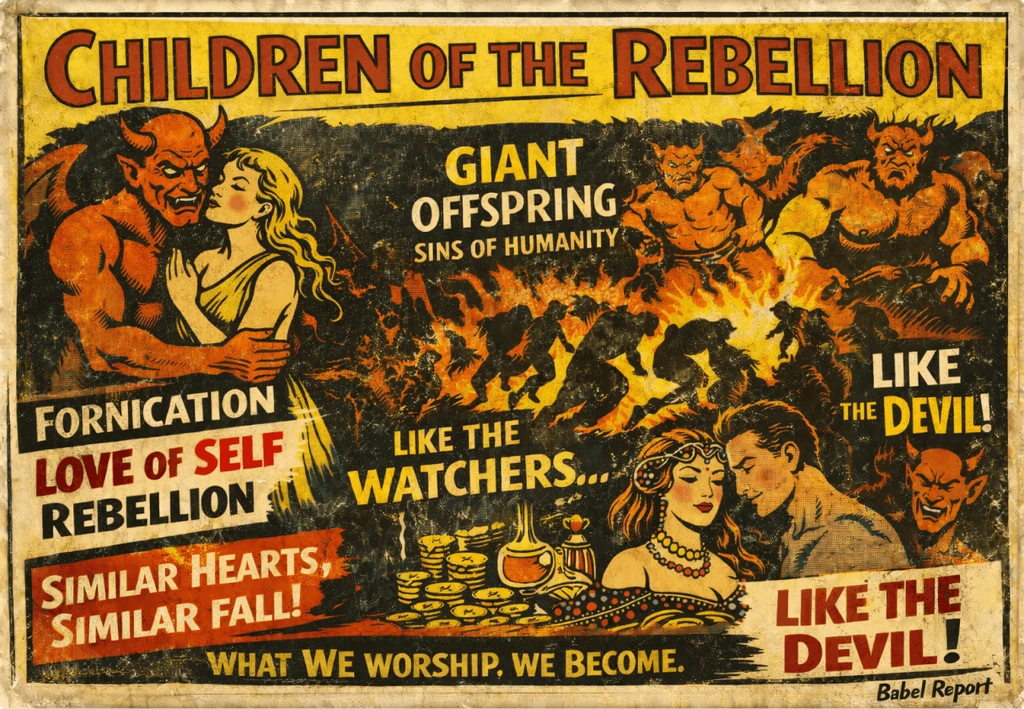
This brings us to a question the ancient writers took very seriously, one we tend to avoid: Does human lust share the same character as the Watchers' rebellion? The answer, according to the texts, is unambiguous.
In the Testament of Reuben, the patriarch explicitly draws a parallel between ordinary human experience and the fall of the Watchers. He warns his children about the "spirit of fornication" and explains that this spirit operates in humans precisely as it did in the angelic rebels, captivating the mind, overwhelming the will, separating the person from the Creator. The Damascus Document found at Qumran places the Watchers at the head of a list of those who fell because they "walked in the stubbornness of their hearts." Their giant children and subsequent human sinners are grouped together under the same heading: those who "did their own will" rather than keeping the commandments of their Maker.
Now, in the biblical world, "sonship" or being a "child" of someone often refers to character and behavior rather than biology alone. A son reflects the image and likeness of his father. Jesus (YHWShA) operates on precisely this logic when he tells the peacemakers they will be called "sons of God" because they reflect the character of the heavenly Father. Conversely, in John's Gospel and First Epistle, those who practice sin are called "children of the devil" (1 John 3:10). Not because they were physically spawned by the adversary, but because their spiritual orientation mirrors his. They have joined that family line by the direction of their worship.
Here is the mechanism that the Psalmist and the prophet Isaiah understood: we become like what we worship. Psalm 115 describes the idols of the nations as having mouths that cannot speak, eyes that cannot see, ears that cannot hear. The terrifying judgment that follows is this: those who make them and trust in them will become like them. They become spiritually lifeless, deaf, and blind. When we worship the creature rather than the Creator, we shrink. We cease to bear the divine image fully. Idolatry is, in this sense, radical self-harm. It creates a disorder where humans, who were made to rule over creation, become enslaved by it.
Paul saw this with devastating clarity. In Romans 1, he describes humanity "exchanging" the glory of God for images of created things. The result is that God "gave them up" to degrading passions. The Watchers exchanged their heavenly glory for the flesh of earth. When a human being treats another person as an object to be consumed rather than an image-bearer to be honored, the same exchange is taking place. The cosmic fall is being reenacted in miniature, in the privacy of the heart, a thousand times a day.
From Idolatry to Exile
This is where the story of Israel comes into sharp focus, and we cannot understand the plight of Israel, the mission of Jesus, or the vocation of the Church unless we grasp what follows.
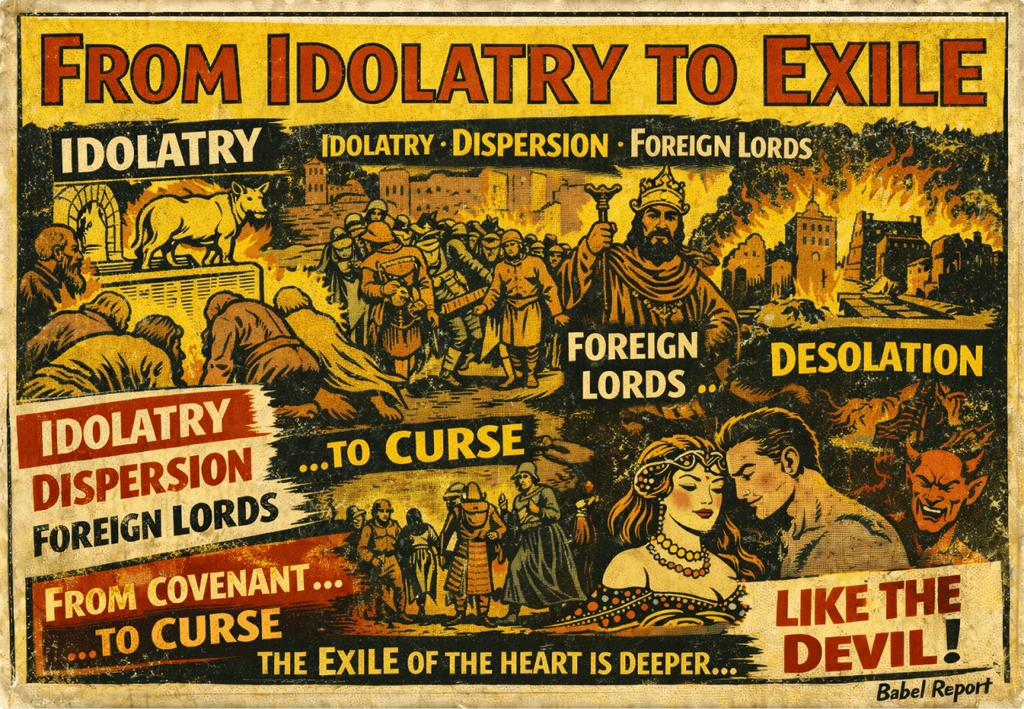
God called Israel to be the solution to the world's problem. They were to be the true humanity that would shine his light into the darkness, the family through whom Adam's failure would be reversed and Abraham's promise fulfilled. But Israel, too, is "in Adam." They recapitulated the primal sin. The covenant in Deuteronomy, particularly chapters 27 through 30, laid out a stark choice: worship the living God and flourish in the land, or turn to idols and face the ultimate covenantal consequence. That consequence is exile. Just as Adam and Eve were expelled from the Garden for their rebellion, Israel was expelled from the land for their idolatry.
And here is the point that many readers miss entirely. Even though the Jews returned geographically from Babylon, the theological and spiritual reality of exile continued. The pagans were still ruling over them. As Ezra and Nehemiah lamented, "We are slaves in our own land." The presence of foreign overlords was the visible sign that the sin of idolatry had not yet been fully dealt with. The return from exile, in the deepest sense, had not yet happened.
It is fair to assume that in many a Bible study across the West, someone has raised the obvious question: why did the Jews in Jesus' day seem so desperate for a deliverer if they had already come back from Babylon? The question tends to hang in the room, because most of us were never taught to think about exile as anything other than a geographical event with a neat historical ending. But exile, as the prophets understood it, was not primarily about location. It was about the condition of the heart and the reign of foreign powers, both visible and invisible. As long as the people of God were bowing to things that were not God, they remained in exile, no matter which city they happened to inhabit.
The Deuteronomic logic is precise. Idolatry leads to exile, which is the disintegration of the human vocation. You were made to bear the image of the Creator into the world, to tend the garden, to exercise wise stewardship over creation. When you worship something other than the Creator, you lose the capacity to do the very thing you were designed for. You become enslaved by what you were meant to govern. That is exile. And it is the condition of the entire human race, not merely ancient Israel.
The Subversive Act of True Worship
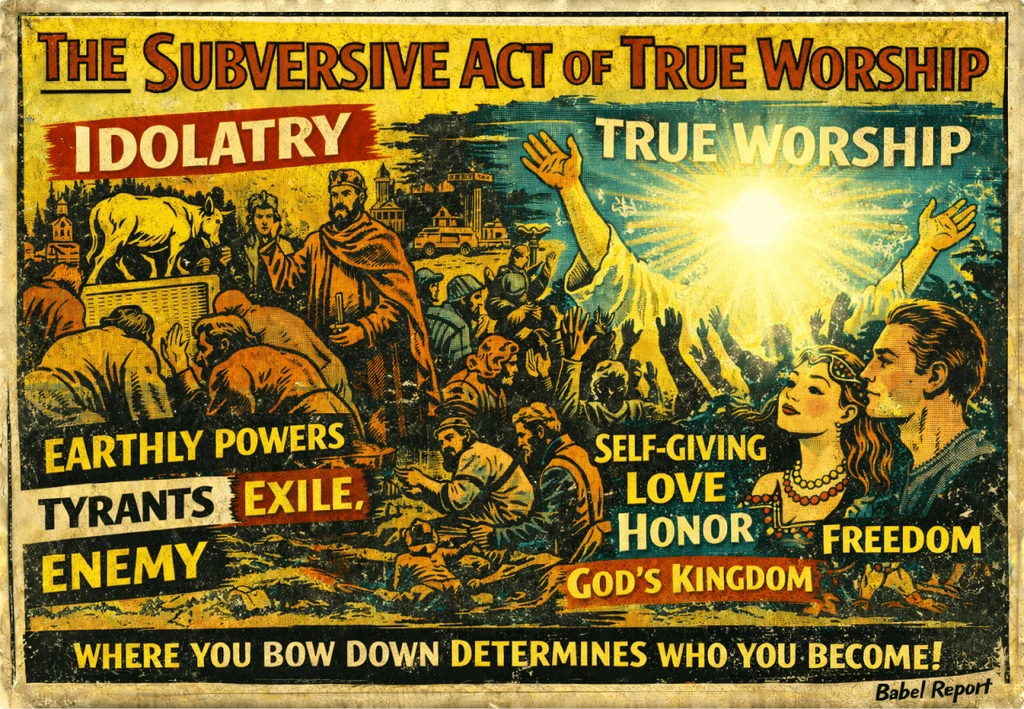
If idolatry enslaves and leads to exile, then the worship of the true God is the only road to freedom. This is not merely about singing songs on a Sunday morning, though it includes that. It is about allegiance. It is about naming which story you intend to live inside.
In the first century, worshipping the God of Israel and specifically acclaiming Jesus as Lord was a politically charged act. It declared that if Jesus is Lord, then Caesar is not. Every tyrant who has ever acted as though he were divine has understood, instinctively, the threat posed by a people who worship someone else. The subversive nature of true worship is that it refuses to grant ultimate authority to any earthly power. It insists, quietly and firmly, that there is a king above every king and a kingdom that cannot be shaken.
But the political dimension is only part of it. The deeper reality is that worship restores us. Just as worshipping idols dehumanizes, worshipping the Creator God reverses the damage. When we gaze in love at the God in whose image we were made, we grow. We become more truly human. The "sensory malfunction" caused by idolatry, the deafness and blindness described by the Psalmist, begins to heal. We start to see other people not as objects to be consumed but as fellow image-bearers to be honored.
I have noticed, in my own journey from Catholic sacramentalism through Pentecostal fervor and into the Scriptures themselves, that the traditions which most emphasize worship, not as performance but as orientation of the whole self toward the Creator, tend to produce people of unusual depth and generosity. That is not a coincidence. It is the spiritual law at work: you become like what you worship. The God of Scripture is self-giving love, and those who worship him begin, slowly and imperfectly, to reflect that character back into the world.
The Remedy: New Creation from the Inside Out
So what is the remedy for the ancient rebellion? How do we break the chain that links us to the chaos of the Watchers?
The answer is not a list of arbitrary rules. Nor is it the modern prescription to "follow your heart," since the heart, as we have seen, is frequently the problem. The remedy is the recovery of our true human vocation through the power of the Holy Spirit.
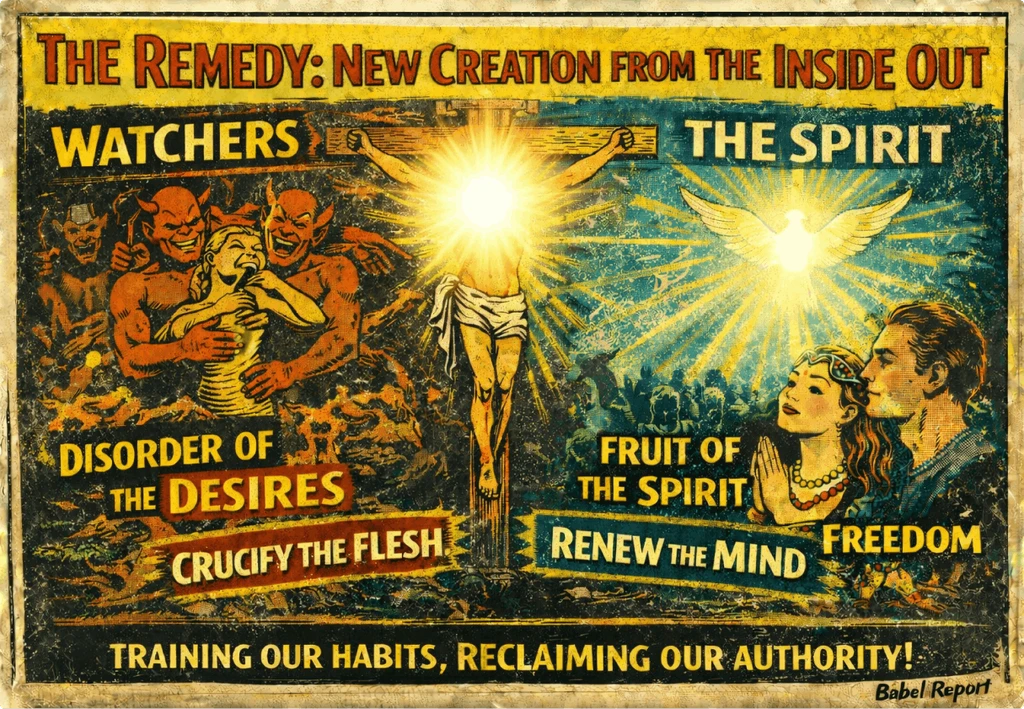
The first battleground is the mind. Paul says it plainly in Romans 12:2: "Be transformed by the renewal of your mind." The error of the Watchers, and subsequently of all idolatry, begins with the mind being captivated by what it sees. Therefore the remedy must begin there as well. We must learn to think differently about who we are. We are not animals driven by biological urges. We are image-bearers of the living God. When we hand our desires over to enslaving powers, we are abdicating the authority we were designed to carry.
This is why the New Testament speaks so starkly about "crucifying the flesh," language that sounds harsh to modern ears but is actually profoundly liberating. It does not mean harming our physical bodies. It means declaring that the old version of ourselves, the version that allied itself with the rebellion, died with the Messiah on the cross. Paul writes in Galatians 5:24 that "those who belong to the Messiah Jesus have crucified the flesh with its passions and desires." We must view those desires not as authentic expressions of our personality to be indulged but as invaders trying to kill our true humanity. We must treat them as a dead thing that has no more authority over us.
And then comes the hard, patient work that the ancient philosophers called the development of virtue and that Paul describes as the fruit of the Spirit. Just as an athlete trains muscles or a musician practices scales, a follower of Jesus must practice the habits of the Spirit until they become second nature. Self-control, patience, kindness, generosity: these are not natural talents that some people happen to possess. They are hard-won qualities that grow through repeated practice, through a thousand small decisions to choose the Creator's design over the clamoring of disordered desire.
Sometimes the only virtue is to flee, just as Joseph ran from Potiphar's wife. There are moments when the wisest and most courageous thing a person can do is simply refuse to remain in the room. We must refuse to let the eye dwell on what is not ours. But fleeing is not the whole story. We must also learn to redirect the power that God gave us. Humans were made to exercise dominion over creation. When we give that power away to an idol, whether it takes the form of another person's body or a bank account or a political ideology, we are doing the opposite of what we were made for. The remedy is to reclaim that authority by exercising self-control, which is the hallmark of the "royal priesthood" Peter describes. We rule over the world by first ruling over ourselves.
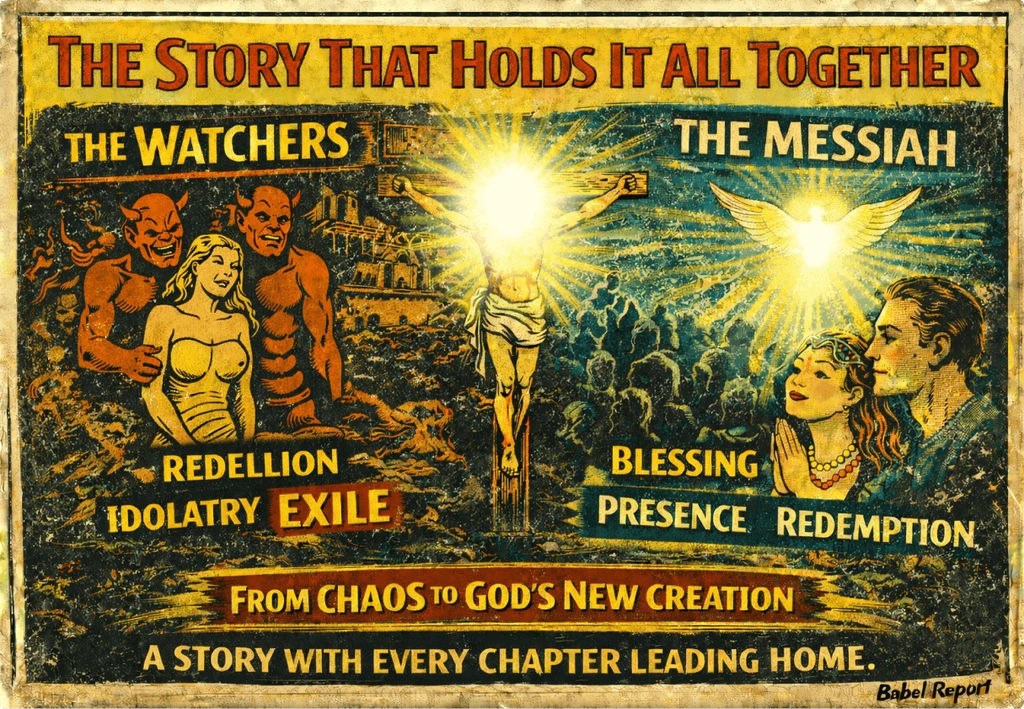
The Story That Holds It All Together
And so we return to where we began, to a story most of us were never told.
The Watchers abandoned their vocation and unleashed chaos. Their rebellion became a pattern that has replicated itself in every human heart, in every civilization, in every generation since. Idolatry leads to exile, the disintegration of the human being and the scattering of the people of God. The whole creation groans under the weight of misdirected worship, waiting for the children of God to be revealed.
But the story does not end there. On the cross, Jesus drew Israel's destiny, and with it the destiny of the whole human race, onto himself. He took the curse of the law, the exile itself, so that the blessing of Abraham could flow out to the nations. He bore the ultimate consequence of the idolatry that had kept humanity in slavery. And in his resurrection, he inaugurated the new creation that the prophets had longed for: not an escape from the world but the redemption of it, from the inside out.
The ultimate hope for the end of exile was always the return of God's presence to dwell among his people. The Temple had been the place where heaven and earth met, the bridgehead for God's presence in a world gone wrong. In Jesus, that Temple was rebuilt. Not in stone but in flesh. And through his Spirit, the same presence now fills those who turn from idols to worship the living God, making them, as Paul puts it, temples of the Holy Spirit.
This is why worship is the ultimate antidote to every form of disordered desire. Not worship as technique or therapy, but worship as the reorientation of the whole self toward the Creator. God's love is generous and self-giving, whereas lust and idolatry are grasping and self-consuming. By worshipping the Creator, our hearts are expanded and healed, so that we no longer need to consume others to feel whole. We begin to see the world as it actually is: God's good creation, entrusted to image-bearers who are being remade by grace to tend it wisely and love it well.
The shadow of the Watchers is long, and it falls across more of our modern landscape than we typically care to admit. But the light of the new creation is longer still. And for those willing to step out of the old story of grasping and self-destruction and into the new story of self-giving love, the vocation remains. It has always remained. The ancient call to bear the image of the Creator into the world has not been revoked. It has been renewed.
And for anyone willing to listen, that renewal is not a theory or a distant hope. It is an invitation being extended right now, today, in the middle of whatever exile you may find yourself in. The God who made you has not forgotten what you were made for.
You Become What You Worship: The Watchers, Idolatry, and the Road to New Creation
There is a story most of us were never told. Not because it was hidden away in some dusty vault or locked behind the walls of an ancient monastery, though parts of it were preserved in exactly those kinds of places. We were never told it because, somewhere along the way, we decided the story was too strange, too uncomfortable, too far removed from the sensible world of modern faith and respectable theology. We shelved it. We moved on to safer ground.
The story concerns a group of heavenly beings who abandoned their post. They were called the Watchers. And what they did, and what followed from what they did, turns out to be one of the most important threads running through the biblical narrative, from Genesis to Jude and beyond. It is a story about desire and disorder, about worship and its corruption, about exile and the long road home. And if we listen carefully, it is a story about us.

When Heaven Came Undone
We need to transport ourselves back into the world of Second Temple Judaism to understand what is actually happening in the opening verses of Genesis 6. Modern readers tend to skim over these lines with a kind of embarrassed shrug, as if the biblical writers made a mistake they would rather we not examine too closely. The ancient Jewish readers did no such thing. They saw in those verses the hinge upon which the drama of human corruption turns.
The Book of the Watchers, preserved in the collection known as 1 Enoch, tells the story in vivid detail. The "sons of heaven" saw the daughters of men and desired them. They descended from their proper station, took human wives, and produced offspring of monstrous proportion and appetite. The text was widely read in the first century. It shaped how Jews and early Christians understood evil, judgment, and the nature of spiritual rebellion. It was not a curiosity filed under "things we no longer believe." It was part of the air they breathed.
Now, here is what strikes me as most remarkable about this tradition. The motivation for the Watchers' descent was not some grand ideological revolt. It was not a philosophical disagreement with the Almighty. It was desire. They saw, and they wanted. The Testament of Reuben describes them as "filled with desire" and says they "perpetrated the act in their minds" before they ever took physical form to carry it out. The corruption began in the mind. The physical violation of the cosmic order came second.
This echoes something older still. In the Garden, Eve "saw" the fruit and desired it. The pattern is the same: seeing, wanting, seizing. And in both cases, the result is catastrophe. Not because God (YHWH) is petty or vengeful, but because desire, when it overrides the Creator's design, unravels the fabric of creation itself.

The Anatomy of Disordered Desire
We must be careful here not to reduce this to a simple morality tale about sexual temptation, though that element is certainly present. What the ancient writers are describing is something far more profound. They are describing what happens when any creature, whether angelic or human, refuses to keep the station assigned to it by the Creator. This is what Jude refers to when he speaks of angels who "did not keep to their own domain but deserted their proper dwelling" (Jude 6).
One can understand, perhaps, the instinct to interpret this story as a quaint relic, a piece of ancient mythology best left to specialists and footnotes. And there is a kind of sophistication in that dismissal. But what you cannot do, if you want to remain coherent, is dismiss this story and then wonder why the world feels disordered. The biblical writers are offering an explanation for the chaos. We would do well to listen before we argue.
For a first-century Jew, the "sin" of the Watchers was not merely a private moral failing. It was a form of idolatry. They were spiritual beings who chose to act like "children of earth." God (Alohim) rebukes them in 1 Enoch by pointing out that marriage and reproduction belong to mortal creatures who need them. The Watchers, being immortal, had no such need. They were seizing a mode of existence that did not belong to them. And in doing so, they introduced a corruption that spread through the entire human family like fire through dry timber.
There is another layer here that we ought not to miss. The tradition tells us that the Watchers did not merely take wives. They also taught humanity illicit knowledge. The fallen angel Azazel taught the making of jewelry, cosmetics, and weapons of war. These were viewed not as neutral technologies but as tools of seduction and violence, instruments that would, in turn, inflame the very desires that had brought the Watchers down in the first place. We see here a vicious cycle: the angels surrender to disordered desire, and in doing so they teach humanity how to become more desirable, more violent, more thoroughly corrupted. The ancient writers like Tertullian later picked up on this, arguing that elaborate ornamentation was introduced by the fallen powers to assault human integrity.
That is the nature of idolatry. It does not stay contained. It metastasizes.

Children of the Rebellion
This brings us to a question the ancient writers took very seriously, one we tend to avoid: Does human lust share the same character as the Watchers' rebellion? The answer, according to the texts, is unambiguous.
In the Testament of Reuben, the patriarch explicitly draws a parallel between ordinary human experience and the fall of the Watchers. He warns his children about the "spirit of fornication" and explains that this spirit operates in humans precisely as it did in the angelic rebels, captivating the mind, overwhelming the will, separating the person from the Creator. The Damascus Document found at Qumran places the Watchers at the head of a list of those who fell because they "walked in the stubbornness of their hearts." Their giant children and subsequent human sinners are grouped together under the same heading: those who "did their own will" rather than keeping the commandments of their Maker.
Now, in the biblical world, "sonship" or being a "child" of someone often refers to character and behavior rather than biology alone. A son reflects the image and likeness of his father. Jesus (YHWShA) operates on precisely this logic when he tells the peacemakers they will be called "sons of God" because they reflect the character of the heavenly Father. Conversely, in John's Gospel and First Epistle, those who practice sin are called "children of the devil" (1 John 3:10). Not because they were physically spawned by the adversary, but because their spiritual orientation mirrors his. They have joined that family line by the direction of their worship.
Here is the mechanism that the Psalmist and the prophet Isaiah understood: we become like what we worship. Psalm 115 describes the idols of the nations as having mouths that cannot speak, eyes that cannot see, ears that cannot hear. The terrifying judgment that follows is this: those who make them and trust in them will become like them. They become spiritually lifeless, deaf, and blind. When we worship the creature rather than the Creator, we shrink. We cease to bear the divine image fully. Idolatry is, in this sense, radical self-harm. It creates a disorder where humans, who were made to rule over creation, become enslaved by it.
Paul saw this with devastating clarity. In Romans 1, he describes humanity "exchanging" the glory of God for images of created things. The result is that God "gave them up" to degrading passions. The Watchers exchanged their heavenly glory for the flesh of earth. When a human being treats another person as an object to be consumed rather than an image-bearer to be honored, the same exchange is taking place. The cosmic fall is being reenacted in miniature, in the privacy of the heart, a thousand times a day.

From Idolatry to Exile
This is where the story of Israel comes into sharp focus, and we cannot understand the plight of Israel, the mission of Jesus, or the vocation of the Church unless we grasp what follows.
God called Israel to be the solution to the world's problem. They were to be the true humanity that would shine his light into the darkness, the family through whom Adam's failure would be reversed and Abraham's promise fulfilled. But Israel, too, is "in Adam." They recapitulated the primal sin. The covenant in Deuteronomy, particularly chapters 27 through 30, laid out a stark choice: worship the living God and flourish in the land, or turn to idols and face the ultimate covenantal consequence. That consequence is exile. Just as Adam and Eve were expelled from the Garden for their rebellion, Israel was expelled from the land for their idolatry.
And here is the point that many readers miss entirely. Even though the Jews returned geographically from Babylon, the theological and spiritual reality of exile continued. The pagans were still ruling over them. As Ezra and Nehemiah lamented, "We are slaves in our own land." The presence of foreign overlords was the visible sign that the sin of idolatry had not yet been fully dealt with. The return from exile, in the deepest sense, had not yet happened.
It is fair to assume that in many a Bible study across the West, someone has raised the obvious question: why did the Jews in Jesus' day seem so desperate for a deliverer if they had already come back from Babylon? The question tends to hang in the room, because most of us were never taught to think about exile as anything other than a geographical event with a neat historical ending. But exile, as the prophets understood it, was not primarily about location. It was about the condition of the heart and the reign of foreign powers, both visible and invisible. As long as the people of God were bowing to things that were not God, they remained in exile, no matter which city they happened to inhabit.
The Deuteronomic logic is precise. Idolatry leads to exile, which is the disintegration of the human vocation. You were made to bear the image of the Creator into the world, to tend the garden, to exercise wise stewardship over creation. When you worship something other than the Creator, you lose the capacity to do the very thing you were designed for. You become enslaved by what you were meant to govern. That is exile. And it is the condition of the entire human race, not merely ancient Israel.

The Subversive Act of True Worship
If idolatry enslaves and leads to exile, then the worship of the true God is the only road to freedom. This is not merely about singing songs on a Sunday morning, though it includes that. It is about allegiance. It is about naming which story you intend to live inside.
In the first century, worshipping the God of Israel and specifically acclaiming Jesus as Lord was a politically charged act. It declared that if Jesus is Lord, then Caesar is not. Every tyrant who has ever acted as though he were divine has understood, instinctively, the threat posed by a people who worship someone else. The subversive nature of true worship is that it refuses to grant ultimate authority to any earthly power. It insists, quietly and firmly, that there is a king above every king and a kingdom that cannot be shaken.
But the political dimension is only part of it. The deeper reality is that worship restores us. Just as worshipping idols dehumanizes, worshipping the Creator God reverses the damage. When we gaze in love at the God in whose image we were made, we grow. We become more truly human. The "sensory malfunction" caused by idolatry, the deafness and blindness described by the Psalmist, begins to heal. We start to see other people not as objects to be consumed but as fellow image-bearers to be honored.
I have noticed, in my own journey from Catholic sacramentalism through Pentecostal fervor and into the Scriptures themselves, that the traditions which most emphasize worship, not as performance but as orientation of the whole self toward the Creator, tend to produce people of unusual depth and generosity. That is not a coincidence. It is the spiritual law at work: you become like what you worship. The God of Scripture is self-giving love, and those who worship him begin, slowly and imperfectly, to reflect that character back into the world.

The Remedy: New Creation from the Inside Out
So what is the remedy for the ancient rebellion? How do we break the chain that links us to the chaos of the Watchers?
The answer is not a list of arbitrary rules. Nor is it the modern prescription to "follow your heart," since the heart, as we have seen, is frequently the problem. The remedy is the recovery of our true human vocation through the power of the Holy Spirit.
The first battleground is the mind. Paul says it plainly in Romans 12:2: "Be transformed by the renewal of your mind." The error of the Watchers, and subsequently of all idolatry, begins with the mind being captivated by what it sees. Therefore the remedy must begin there as well. We must learn to think differently about who we are. We are not animals driven by biological urges. We are image-bearers of the living God. When we hand our desires over to enslaving powers, we are abdicating the authority we were designed to carry.
This is why the New Testament speaks so starkly about "crucifying the flesh," language that sounds harsh to modern ears but is actually profoundly liberating. It does not mean harming our physical bodies. It means declaring that the old version of ourselves, the version that allied itself with the rebellion, died with the Messiah on the cross. Paul writes in Galatians 5:24 that "those who belong to the Messiah Jesus have crucified the flesh with its passions and desires." We must view those desires not as authentic expressions of our personality to be indulged but as invaders trying to kill our true humanity. We must treat them as a dead thing that has no more authority over us.
And then comes the hard, patient work that the ancient philosophers called the development of virtue and that Paul describes as the fruit of the Spirit. Just as an athlete trains muscles or a musician practices scales, a follower of Jesus must practice the habits of the Spirit until they become second nature. Self-control, patience, kindness, generosity: these are not natural talents that some people happen to possess. They are hard-won qualities that grow through repeated practice, through a thousand small decisions to choose the Creator's design over the clamoring of disordered desire.
Sometimes the only virtue is to flee, just as Joseph ran from Potiphar's wife. There are moments when the wisest and most courageous thing a person can do is simply refuse to remain in the room. We must refuse to let the eye dwell on what is not ours. But fleeing is not the whole story. We must also learn to redirect the power that God gave us. Humans were made to exercise dominion over creation. When we give that power away to an idol, whether it takes the form of another person's body or a bank account or a political ideology, we are doing the opposite of what we were made for. The remedy is to reclaim that authority by exercising self-control, which is the hallmark of the "royal priesthood" Peter describes. We rule over the world by first ruling over ourselves.

The Story That Holds It All Together
And so we return to where we began, to a story most of us were never told.
The Watchers abandoned their vocation and unleashed chaos. Their rebellion became a pattern that has replicated itself in every human heart, in every civilization, in every generation since. Idolatry leads to exile, the disintegration of the human being and the scattering of the people of God. The whole creation groans under the weight of misdirected worship, waiting for the children of God to be revealed.
But the story does not end there. On the cross, Jesus drew Israel's destiny, and with it the destiny of the whole human race, onto himself. He took the curse of the law, the exile itself, so that the blessing of Abraham could flow out to the nations. He bore the ultimate consequence of the idolatry that had kept humanity in slavery. And in his resurrection, he inaugurated the new creation that the prophets had longed for: not an escape from the world but the redemption of it, from the inside out.
The ultimate hope for the end of exile was always the return of God's presence to dwell among his people. The Temple had been the place where heaven and earth met, the bridgehead for God's presence in a world gone wrong. In Jesus, that Temple was rebuilt. Not in stone but in flesh. And through his Spirit, the same presence now fills those who turn from idols to worship the living God, making them, as Paul puts it, temples of the Holy Spirit.
This is why worship is the ultimate antidote to every form of disordered desire. Not worship as technique or therapy, but worship as the reorientation of the whole self toward the Creator. God's love is generous and self-giving, whereas lust and idolatry are grasping and self-consuming. By worshipping the Creator, our hearts are expanded and healed, so that we no longer need to consume others to feel whole. We begin to see the world as it actually is: God's good creation, entrusted to image-bearers who are being remade by grace to tend it wisely and love it well.
The shadow of the Watchers is long, and it falls across more of our modern landscape than we typically care to admit. But the light of the new creation is longer still. And for those willing to step out of the old story of grasping and self-destruction and into the new story of self-giving love, the vocation remains. It has always remained. The ancient call to bear the image of the Creator into the world has not been revoked. It has been renewed.
And for anyone willing to listen, that renewal is not a theory or a distant hope. It is an invitation being extended right now, today, in the middle of whatever exile you may find yourself in. The God who made you has not forgotten what you were made for.

EXPLORE MORE
Name For Satan

The Book of Enoch calls Gadrel Eve’s deceiver, hinting Satan once had another name. If “Satan” was a title, Gadrel may be it.
LEARN MORE
Breath Of Life

The breath of God and the Holy Spirit spark a journey of transformation, offering eternal life and hope through every challenge.
LEARN MORE
Word Made Flesh

ohn’s Gospel reveals Alohim’s unity through His Son and extends the call for all to receive Him and live as children of God.
LEARN MORE
EXPLORE MORE
Name For Satan

The Book of Enoch calls Gadrel Eve’s deceiver, hinting Satan once had another name. If “Satan” was a title, Gadrel may be it.
LEARN MORE
Breath Of Life

The breath of God and the Holy Spirit spark a journey of transformation, offering eternal life and hope through every challenge.
LEARN MORE
Word Made Flesh

ohn’s Gospel reveals Alohim’s unity through His Son and extends the call for all to receive Him and live as children of God.
LEARN MORE
EXPLORE MORE
Name For Satan

The Book of Enoch calls Gadrel Eve’s deceiver, hinting Satan once had another name. If “Satan” was a title, Gadrel may be it.
LEARN MORE
Breath Of Life

The breath of God and the Holy Spirit spark a journey of transformation, offering eternal life and hope through every challenge.
LEARN MORE
Word Made Flesh

ohn’s Gospel reveals Alohim’s unity through His Son and extends the call for all to receive Him and live as children of God.
LEARN MORE