
The conventional reading of the James Paul debate has created one of Christianity's most persistent puzzles. Two apostles apparently locked in theological combat over the very heart of the gospel. James insists that "faith without works is dead," while Paul thunders that we are "justified by faith apart from works of the law." Scholars have spilled oceans of ink trying to harmonize these voices, often missing the forest for the theological trees. But what if the contradiction itself rests on a fundamental misunderstanding of what these men were actually arguing about?
Here is what strikes me as most remarkable about this debate: both men wrote as diaspora Jews. Their covenant identity had been reshaped by centuries of displacement, not as systematic theologians debating individual salvation mechanics. The historical evidence suggests we have been watching a shadow-boxing match where no real fight existed. When we locate both apostles within the concrete struggles of diaspora Jewish communities wrestling with gentile inclusion and covenant faithfulness, their supposed contradiction dissolves into complementary pastoral wisdom addressing the same fundamental question from different angles.
The Exile That Shaped Two Apostles
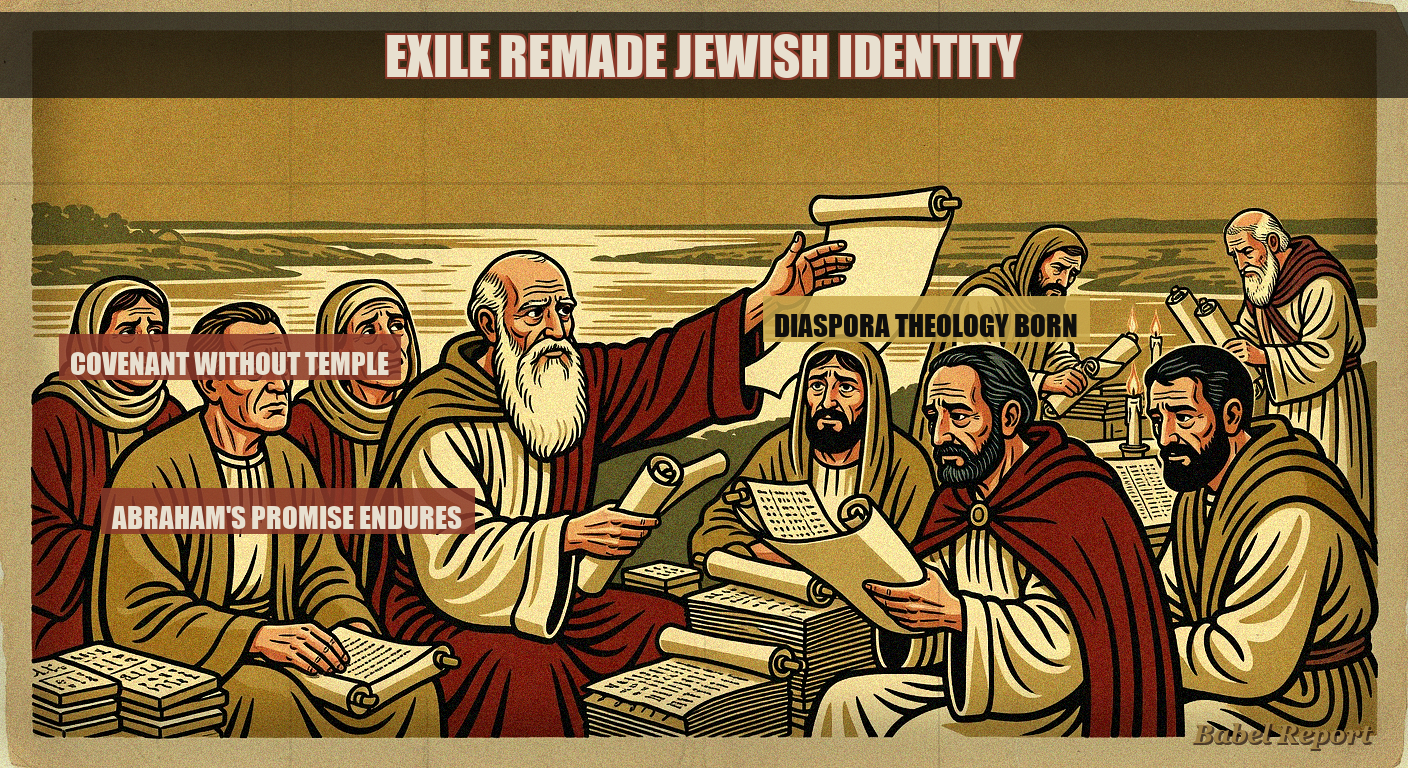
Diaspora Judaism's Theological Revolution
To understand James and Paul, we must first grasp the theological earthquake that had already reshaped Jewish identity long before either man put stylus to papyrus. The Babylonian exile and its aftermath had forced Jewish communities to reimagine covenant relationship with God (YHWH), in ways their ancestors could never have anticipated. No longer could covenant faithfulness be measured simply by temple attendance, sacrificial participation, or residence in the promised land.
The exile created what we might call a "portable theology" (the essence of exile theology). Jewish communities scattered across the Mediterranean had learned to maintain covenant identity through synagogue worship, Torah study, dietary observance, and care for the vulnerable within their communities. This was not a diluted Judaism but a concentrated one. Diaspora Jews understood themselves as still fully Israel, but an Israel whose boundaries had been stretched, whose practices had been refined, and whose mission had been clarified through centuries of displacement.
So far, we understand the historical background. But here is the crucial insight: both James and Paul inherited this already-transformed Judaism. Neither wrote from within the temple-centered covenant theology of pre-exilic Israel. Both assumed that God's covenant people could maintain their identity while scattered among the nations. The question was not whether such scattered identity was possible. The exile had already answered that. The question was who belonged within this redefined covenant community, and how that belonging should be expressed.
Second Temple Crisis of Belonging
The concrete pastoral challenge both apostles inherited centered on a specific crisis of belonging. If exile had already stretched the boundaries of Jewish covenant identity, what happened when gentiles began claiming participation in that same covenant through faith in Jesus (YHWShA), the Jewish Messiah? This was not an abstract theological puzzle but a daily community management crisis.
Consider the situation: Jewish Christian communities throughout the diaspora suddenly found themselves welcoming gentile believers who claimed full participation in Israel's covenant promises. These gentiles had not undergone proselyte conversion. They did not observe Torah in traditional ways. Yet they insisted, based on their experience of God's Spirit and the teaching of Jewish apostles like Paul, that they belonged fully within the covenant community.
This created what we might call an "identity verification crisis." How could diaspora Jewish Christians – who had maintained their covenant identity through careful observance of distinguishing practices recognize genuine covenant membership in people who shared none of those distinguishing markers? The crisis was not about individual salvation but about communal boundaries. Who belonged to the people of God, and how could that belonging be authenticated?
James's Synagogue, Paul's Mixed Communities
The pastoral contexts that shaped each apostle's response to this crisis were fundamentally different, and understanding these differences is crucial for grasping why their language sounds so different. James appears to have written primarily to wealthy Jewish Christian synagogue communities where the question was not gentile inclusion but covenant faithfulness among established members. His concern was that prosperous Jewish Christians, secure in their covenant membership, were neglecting the practical obligations that covenant identity demanded.
Paul, by contrast, wrote primarily to mixed communities where the fundamental question was how gentiles could participate authentically in Israel's covenant story. His forensic language about justification addressed the boundary-marking crisis: what criteria determined genuine covenant membership when traditional ethnic and ritual markers could no longer serve as reliable indicators?
These were not contradictory theological positions but complementary pastoral responses to different manifestations of the same underlying question: how should covenant identity operate in the new situation created by the Messiah's coming? James addressed covenant maintenance within established Jewish Christian communities. Paul addressed covenant access for incoming gentile believers.
The Language of Law in Two Different Conversations
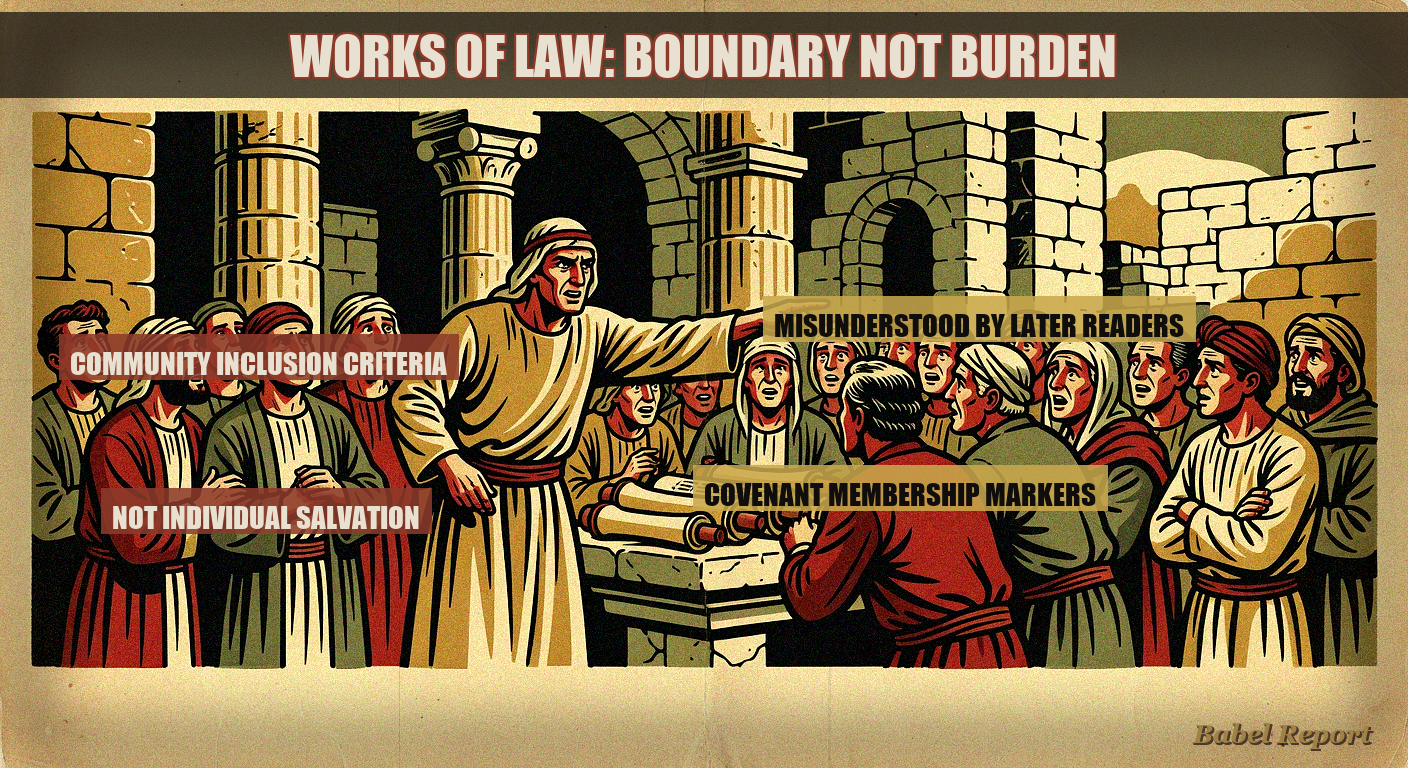
Paul's "Works of the Law" as Boundary Markers
Paul's famous phrase "works of the law" has been consistently misunderstood because interpreters have read it through the lens of later Protestant concerns about earning salvation rather than through the lens of Second Temple Jewish community boundary marking. When Paul argued that gentiles were justified apart from "works of the law," he was not establishing a principle about how individuals obtain right standing with God. He was addressing a specific question about community inclusion criteria.
The "works of the law" Paul had in mind were precisely those practices that marked Jewish identity within the diaspora: circumcision, dietary laws, sabbath observance, and festival participation. These were not arbitrary religious requirements but the very practices through which diaspora Jewish communities maintained their covenant distinctiveness among the nations. Paul's argument was theological but also intensely practical: requiring gentile believers to adopt these boundary markers would effectively require them to become ethnic Jews before they could participate in the covenant that God had always intended to include the nations.
This was, as Paul understood it, a matter of theological principle rooted in the Abrahamic covenant itself. The freedom he advocated was not freedom from moral obligation but freedom for gentiles to participate in Israel's covenant story as gentiles. Paul saw this as the fulfillment, not the abandonment, of what God had promised Abraham: that through his seed all the nations of the earth would be blessed.
James's "Works of Faith" as Covenant Faithfulness
James's language about works emerges from an entirely different conversation. When James insisted that "faith without works is dead," he was not responding to Paul's teaching about gentile inclusion. He was addressing a crisis of covenant faithfulness among Jewish Christians who understood themselves as securely within the covenant community but who were failing to live according to covenant obligations.
The "works" James had in mind were not boundary-marking rituals but covenant-expressing relationships: care for widows and orphans, economic justice within the community, refusal to show partiality based on wealth or social status. These were precisely the obligations that the Hebrew prophets had identified as the heart of covenant faithfulness. James was essentially arguing that authentic covenant membership necessarily expresses itself through covenant-shaped living.
This was not legalism but relationalism. James understood faith as a transformative relationship with the living God, and he insisted that such relationship inevitably produces the kind of community life that reflects God's character. His concern was that some Jewish Christians had adopted a purely theoretical understanding of faith that left their actual community relationships unchanged.
The Chronology Question That Changes Everything
Most readings of the James Paul debate assume that James wrote after Paul's letters had circulated widely and that James was responding to Pauline teaching. But this chronological assumption creates more problems than it solves. If James was responding to Paul, why does his language show no awareness of Paul's specific arguments about gentile inclusion? Why does James never mention the gentile question that so dominated Paul's correspondence?
The more likely scenario is that James wrote before Paul's major letters had achieved wide circulation, addressing problems within Jewish Christian communities that were largely independent of the gentile inclusion questions that would later dominate Paul's ministry. This chronological reordering resolves many of the apparent contradictions between the two apostles. They were not debating each other but addressing different pastoral crises within the same broader theological world.
This timing also explains why James's language about Abraham focuses on his faithfulness rather than on his role as father of many nations. James was addressing Jewish Christians who needed to understand how their covenant identity should express itself in community life, not gentile Christians who needed to understand how they could participate in that covenant identity at all.
Gentile Inclusion Within Covenant Redefinition
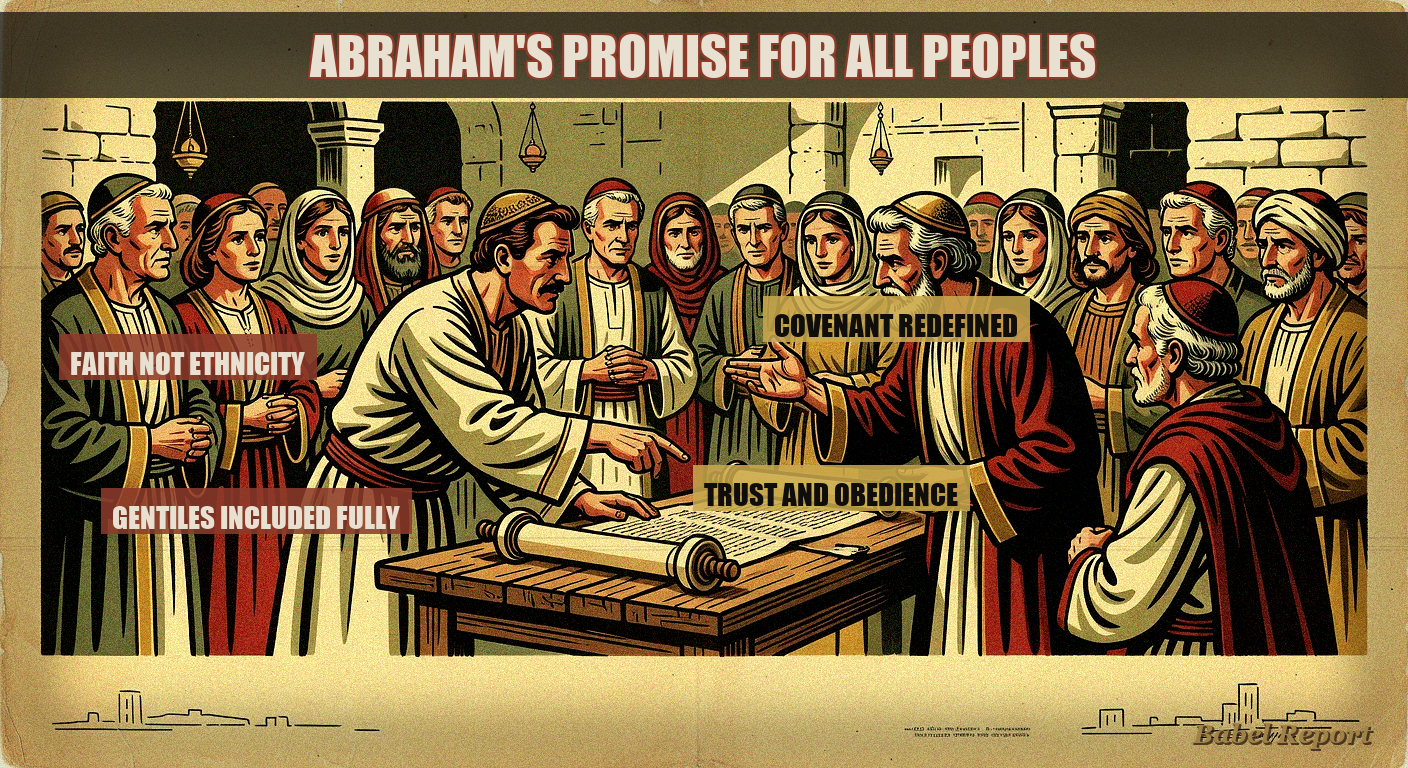
Abraham's Promise Beyond Ethnic Israel
Both James and Paul understood Jesus as the fulfillment of God's covenant promises to Abraham, but they approached this fulfillment from different angles based on their different pastoral concerns. Paul emphasized how Abraham's faith preceded his circumcision, establishing the principle that covenant relationship with God was fundamentally about trust rather than ethnic identity or ritual observance. This enabled Paul to argue that gentiles could participate fully in the Abrahamic covenant without first becoming ethnically Jewish.
James emphasized how Abraham's faith expressed itself through concrete action, particularly his willingness to offer Isaac in obedience to God's command. This enabled James to argue that authentic covenant relationship necessarily transforms how people treat each other within the covenant community. Both emphases were entirely consistent with Second Temple Jewish understanding of the Abrahamic covenant, but each served different pastoral purposes.
The crucial insight is that neither apostle saw gentile inclusion as requiring the abandonment of Jewish covenant identity. Paul did not argue that the coming of the Messiah had made Jewish practices irrelevant. James did not argue that gentile believers needed to adopt Jewish practices to be authentic Christians. Both understood that the Messiah had fulfilled and clarified the Abrahamic covenant's always-intended universal scope while preserving the covenant's character as expressed through Israel's story.
The Shared Enemy Neither Apostle Named
Here lies the insight that resolves the apparent contradiction between James and Paul: both apostles opposed the same fundamental error, though they encountered it in different forms within their respective communities. The error was the notion that covenant membership could exist without covenant transformation.
For Paul, this error appeared among Jewish Christians who insisted that gentile believers must adopt Jewish boundary markers to prove their covenant membership. Paul argued that this position misunderstood both the nature of covenant membership (which was always about faith in God's promises) and the purpose of Israel's distinctive practices (which were meant to preserve covenant identity until the Messiah came to extend it to the nations).
For James, this error appeared among Jewish Christians who assumed that their secure covenant membership exempted them from covenant obligations, particularly the obligation to care for the vulnerable within their communities. James argued that this position misunderstood the nature of faith itself, which necessarily expresses itself through the kind of life that reflects God's character.
Neither apostle fought the other. Both fought the notion that covenant relationship with God could be separated from covenant-shaped living. Their different emphases reflected their different pastoral contexts, not their different theological convictions.
Reading the Letters Within Diaspora Community Life
James's Wealthy Jewish Christians and Social Justice
James's letter becomes crystal clear when we locate it within the specific crisis of wealthy Jewish Christian synagogue communities in the diaspora. These communities had maintained their Jewish identity through centuries of displacement, often achieving considerable economic success in their host cities. The coming of the Messiah had confirmed their covenant identity, but it had also created a dangerous temptation: the temptation to assume that covenant security meant covenant immunity from covenant obligations.
James addressed Jewish Christians who were showing partiality to wealthy visitors while ignoring poor members of their own communities. He confronted believers who were withholding wages from laborers and accumulating wealth while fellow covenant members suffered need. This was not a problem of doctrinal confusion but of practical unfaithfulness. These communities understood themselves as covenant people, but they were not living as covenant people.
James's response was pastoral and prophetic. He reminded his readers that authentic faith in the God of Israel necessarily expresses itself through the kind of justice and mercy that the Hebrew prophets had consistently identified as the heart of covenant faithfulness. His insistence that "faith without works is dead" was not a theological correction but a pastoral warning: faith that produces no transformation in how we treat the vulnerable is not genuine faith at all.
Paul's Gentile Converts and Identity Formation
Paul's letters addressed an entirely different pastoral challenge. His communities were filled with gentile believers who had come to faith in the God of Israel through the gospel of Jesus the Messiah, but who lacked the cultural and theological resources to understand their new identity. These believers needed to understand not only how they could participate in Israel's covenant story but also what such participation meant for their daily lives.
Paul's forensic language about justification served this identity formation purpose. When Paul argued that gentiles were justified by faith apart from works of the law, he was providing these communities with the theological framework they needed to understand their full inclusion within God's covenant people. When Paul insisted that all believers, Jew and gentile alike, had access to God through the same Spirit, he was reshaping their consciousness so that they understood themselves as participants in the covenant community.
But Paul never separated justification from transformation. His letters consistently move from theological foundation to practical application, showing how covenant identity necessarily expresses itself through covenant-shaped community life. Paul's ethics were not additions to his gospel but expressions of it.
Two Answers to One Question
When we locate both letters within their proper pastoral contexts, their apparent contradiction dissolves into complementary wisdom. Both apostles addressed communities struggling with the same fundamental question: how should covenant identity with the God of Israel operate in the new situation created by the Messiah's coming and the inclusion of the gentiles?
James answered this question by focusing on covenant maintenance within established Jewish Christian communities. Paul answered it by focusing on covenant access for incoming gentile believers. James emphasized that authentic covenant membership necessarily expresses itself through covenant obligations. Paul emphasized that covenant membership was available to gentiles through faith rather than through ethnic identity or ritual observance.
These were not competing answers but complementary ones. Both understood that the Messiah had fulfilled rather than abandoned God's covenant promises to Israel. Both insisted that authentic covenant relationship with God necessarily transforms how people live in community with each other. Both opposed any separation between divine relationship and human responsibility.
The Covenant Community Exile Had Already Redefined
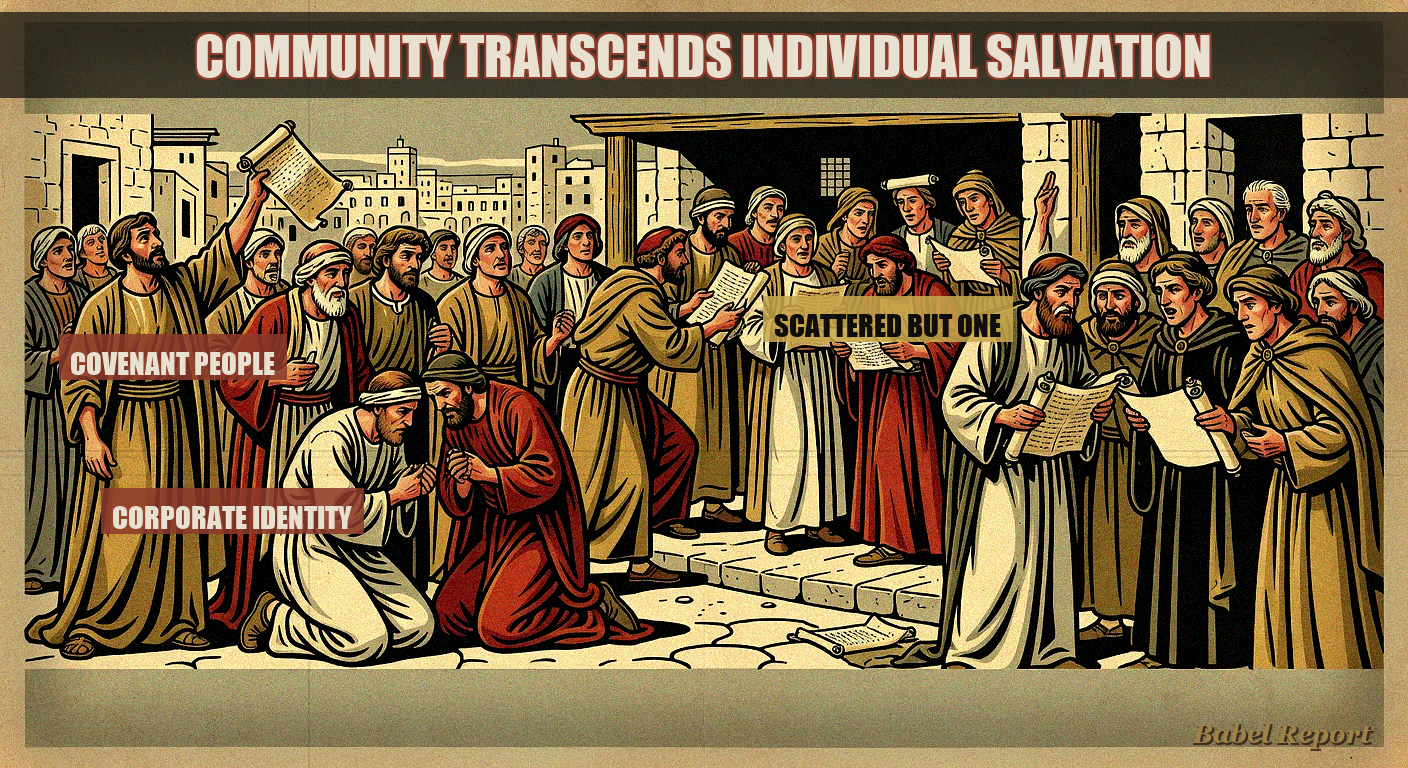
Beyond Individual Salvation Mechanics
The persistent attempt to read James and Paul as debating individual salvation mechanics misses the fundamentally communal orientation of both letters. Neither apostle was primarily concerned with how individuals obtain right standing with God. Both were concerned with how covenant communities should operate in the new situation created by the Messiah's coming and the subsequent inclusion of gentiles within Israel's covenant story.
This communal orientation reflects the diaspora Jewish context from which both apostles wrote. Diaspora Judaism had developed sophisticated understandings of how covenant communities could maintain their identity while scattered among the nations. Both James and Paul assumed this diaspora theological foundation while addressing the new challenges created by gentile inclusion within these same covenant communities.
The Lord (YHWH) had always intended for His covenant with Abraham to encompass all nations, but the practical questions of how such universal inclusion should operate had become urgent with the Messiah's coming. James and Paul provided complementary pastoral wisdom for communities navigating these questions, not competing theological systems about individual salvation.
Diaspora Wisdom for Modern Churches
The historical resolution of the James Paul debate offers profound wisdom for contemporary churches struggling with their own questions of inclusion and faithfulness. Like the first-century diaspora communities that both apostles addressed, modern churches must navigate the tension between maintaining their distinctive identity and welcoming people from diverse backgrounds into full participation in their community life.
James's emphasis on covenant obligations reminds contemporary churches that authentic faith necessarily expresses itself through transformed relationships within the community. Churches that separate faith from justice, that ignore the vulnerable while celebrating their theological correctness, that show partiality based on wealth or social status, fall under the same prophetic critique that James delivered to his Jewish Christian readers.
Paul's emphasis on covenant access reminds contemporary churches that God's grace extends to all people regardless of their cultural background or previous religious experience. Churches that create unnecessary barriers to participation, that confuse cultural preferences with theological requirements, that fail to welcome people who look different or think differently, fall under the same apostolic correction that Paul delivered to his mixed communities.
The wisdom both apostles offer is ultimately pastoral rather than systematic. They were not establishing timeless theological principles but providing practical guidance for specific communities facing particular challenges. Their letters work together to address the full range of questions that covenant communities must navigate: how to welcome new members authentically and how to live faithfully as the people they already are.
Understanding James and Paul as allies rather than enemies provides contemporary churches with resources for addressing their own inclusion and faithfulness challenges. The exile theology that shaped both apostles offers a framework for understanding how God's people can maintain their distinctive identity while fully welcoming people from every background into participation in God's covenant story. The diaspora wisdom they developed remains relevant for churches that, like their first-century counterparts, find themselves scattered among diverse populations while seeking to live faithfully as God's covenant people.
What emerges from this historical investigation is not a resolution of an ancient theological debate but a recognition that no such debate ever existed. James and Paul were pastoral allies addressing different aspects of the same fundamental challenge: how should covenant communities operate in a world where God's promises to Israel were being fulfilled through the inclusion of the nations? Their complementary wisdom continues to guide churches that seek to be both faithful to their covenant identity and genuinely welcoming to all whom God calls into His family. Perhaps, in a world so fractured by debates over inclusion and identity, that is precisely the apostolic guidance we need.


