
Here is something puzzling about John the Baptist that rarely gets the attention it deserves. The man who proclaimed Jesus as the Lamb of God (YHWH), who saw the heavens torn open and heard the voice from above, later sent messengers from his prison cell with a question that has troubled readers for two millennia: "Are you the one who is to come, or should we look for another?" How do we make sense of this apparent crisis of faith from the very prophet who prepared the way for the kingdom of God?
The puzzle deepens when we consider John's context. This was not some wavering believer struggling with basic doctrine. This was the forerunner himself, the voice crying in the wilderness, the one who baptized the Messiah. Yet from his prison cell, doubt crept in. Why?
The answer lies not in John's failure but in the breathtaking scope of what God was actually accomplishing through the carpenter from Nazareth. John experienced firsthand the jarring transition between political liberation theology and Jesus (YHWSh A)'s redefinition of what exile and restoration actually meant. His question from prison becomes not evidence of weak faith but testimony to the most profound paradigm shift in human history.
The Prophet's Prison: Understanding John's Historical Context
Second Temple Jewish Exile Theology
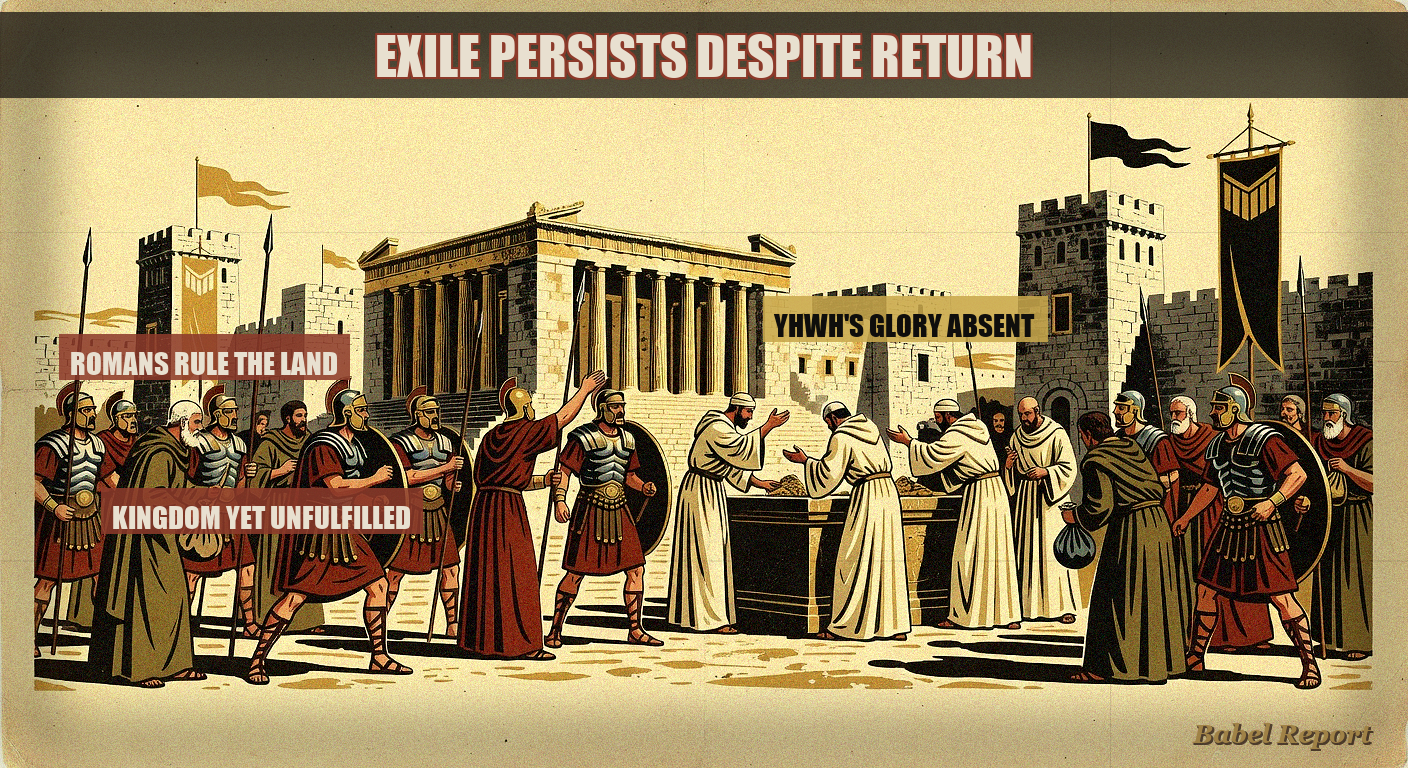
To understand John's doubt, we must first grasp how Second Temple Jews understood their situation. Despite the return from Babylon centuries earlier, most Jews believed they remained in exile. The Temple had been rebuilt, yes, but foreign powers still ruled the land. Romans collected taxes. Gentile governors made decisions. The Davidic line remained powerless. The glory of God (YHWH), whom the Hebrews called Alohim, had not returned as Ezekiel promised.
This was not exile in the narrow sense of physical displacement. It was exile as theological category: separation from God's intended order, alienation from covenant blessing, subjection to foreign powers who did not acknowledge Israel's God. The solution seemed obvious to most. YHWH would return to deliver his people through military conquest, overthrow the pagans, restore the Temple to its full glory, and establish Israel as head of the nations.
This framework shaped every messianic expectation. The coming one would be a warrior-king in David's line, gathering Israel's armies, purifying the land, establishing Jerusalem as the center of divine rule. Exile would end through national restoration. The kingdom would arrive through political liberation.
John's Prophetic Framework
John the Baptist operated squarely within this traditional framework, yet with radical innovations that made his ministry explosive. By gathering people in the Jordan wilderness, he was symbolically declaring a new exodus. The location itself proclaimed the message: here is where Israel crossed into the promised land under Joshua, and here they would cross again under the greater Joshua to come.
But John's innovations went further. By offering water baptism for the forgiveness of sins, he was essentially saying that what you normally received through the Temple cult, you could have here and now in the wilderness. This was not merely religious reform but theological revolution. He was bypassing the entire sacrificial system, suggesting that the Temple establishment had become irrelevant to Israel's preparation for the kingdom.
The political implications were unavoidable. Anyone collecting crowds in the wilderness was making a statement about current leadership. Herod Antipas ruled by Roman appointment, not divine right. The Sadducees controlled the Temple through accommodation with pagans. But in the Jordan valley, John offered an alternative: direct access to covenant renewal, immediate preparation for the coming king, purification that did not depend on compromised institutions.
This message resonated precisely because it fit established patterns. The wilderness had always been the place of Israel's formation. Moses received the Law there. David fled there from Saul. The prophets spoke of Israel's return to wilderness intimacy with YHWH. John was not inventing new categories but revitalizing ancient ones.
The Collision of Expectations
Then Jesus appeared, and everything began shifting in unexpected directions. John recognized him immediately – this was the one he had been preparing the way for. The heavens opened. The Spirit descended. The voice from above confirmed it. John's mission was complete.
But then Jesus began doing things that did not quite fit the script. Instead of gathering an army, he gathered fishermen. Instead of plotting against Rome, he healed Roman centurions' servants. Instead of purifying the Temple through force, he taught in synagogues and ate with tax collectors. Instead of establishing a visible kingdom with clear boundaries, he spoke in parables about seeds and harvests.
The most troubling aspect was not what Jesus was doing but what he was not doing. Where was the judgment on Israel's enemies? Where was the restoration of Davidic rule? Where was the obvious, unmistakable intervention that would end foreign occupation once and for all? The healing ministry was impressive, certainly, but Rome remained in power. The religious establishment continued its compromise. The righteous still suffered while the wicked prospered.
For someone operating within Second Temple Jewish expectations, this created genuine interpretive crisis. Either Jesus was the Messiah and the kingdom was arriving in ways no one anticipated, or Jesus was not the Messiah and they needed to keep waiting for someone else. There was no middle ground.
When Symbols Shift: Jesus Redefining the Kingdom
Healing as Exile-Ending Symbolism
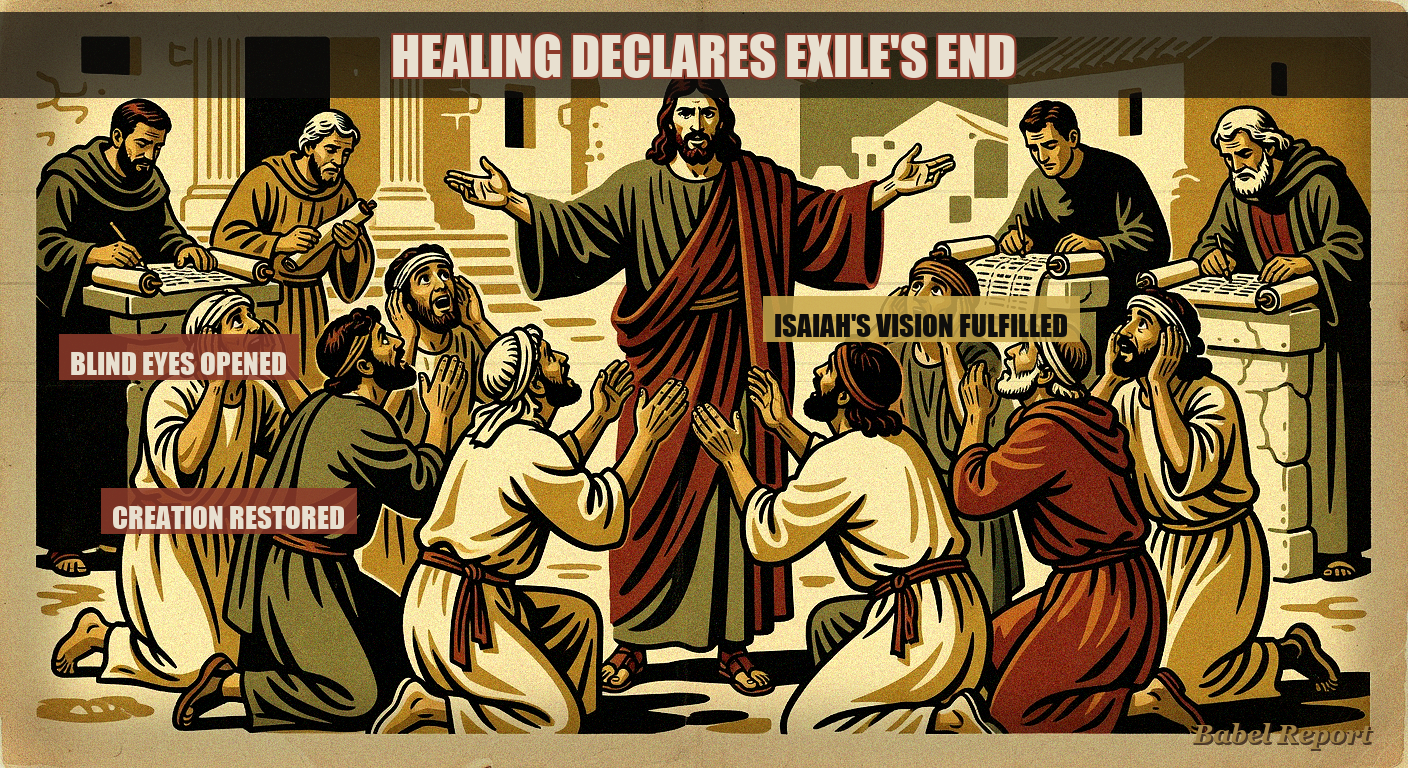
Here is where we must pay careful attention to what Jesus was actually doing, not merely what he was not doing. His healing ministry was not random acts of compassion but deliberate symbolic action declaring the end of exile through creation's renewal. When he opened blind eyes and unstopped deaf ears, when he cleansed lepers and raised the dead, he was enacting Isaiah's vision of restoration in the most literal way possible.
Isaiah had prophesied that when YHWH returned to save his people, "the eyes of the blind shall be opened, and the ears of the deaf unstopped; then shall the lame man leap like a deer, and the tongue of the mute sing for joy." This was not merely individual healing but cosmic restoration. The prophet was describing what would happen when the curse was reversed, when creation itself was set free from bondage to decay.
Jesus intended his mighty works to be understood as fulfillment of this expectation. They were not simply socially subversive (though they were that) or religiously revolutionary (though they were that too). They spoke in the language that symbols can speak, of return and restoration, of the coming of YHWH to save and heal his people. The healings were visible proof that the age to come was breaking into the present age.
But here lay the source of confusion for John and others operating within traditional frameworks. They expected the symbolic and the literal to align differently. If God was returning to end exile, surely that meant immediate political liberation alongside physical healing. If the Messiah was establishing his kingdom, surely that meant visible overthrow of foreign occupation alongside restoration of covenant blessing.
The Deeper Exile Revealed
What John and his contemporaries could not initially grasp was that Jesus was addressing a more fundamental exile than foreign occupation. He was dealing with the exile that made all other exiles inevitable: humanity's alienation from God through sin and death. The Adamic curse was the root problem of which Babylonian exile was merely one historical manifestation.
This deeper exile affected every human being, not just Israel. It was the cosmic disorder that subjected creation to futility, the universal estrangement from God that expressed itself in individual suffering, social injustice, political oppression, and ultimately death itself. No military victory over Rome could address this fundamental problem. No restoration of Davidic rule could reverse the curse that had been operating since Eden.
Jesus was not ignoring Israel's particular story of displacement and return. He was revealing what lay beneath it. Israel's exile under foreign powers was real and painful, but it pointed to the deeper reality of human exile from the presence of God. Israel's hope for restoration was legitimate, but it found its ultimate fulfillment in restoration of the entire created order, not merely one nation's political independence.
This is why the healings mattered so much. They were not distractions from the "real" work of political liberation. They were the real work itself – the reversal of curse, the restoration of creation, the in-breaking of the age to come when God would make all things new. Every blind eye opened was evidence that the exile imposed by sin and death was ending. Every demon cast out was proof that the stronger man was binding the strong man and plundering his house.
Political Liberation vs Cosmic Redemption
The tension John experienced was not between faith and doubt but between two different frameworks for understanding what redemption looked like. Political liberation focused on external circumstances – who held power, which armies controlled territory, what institutions governed religious life. This framework was not wrong, but it was incomplete.
Cosmic redemption focused on the fundamental structures of reality itself – the relationship between God and creation, the power of sin and death, the ultimate destiny of all things. This framework did not deny the importance of politics and justice, but it located them within a larger story about God's purpose for the entire universe.
Jesus was demonstrating that cosmic redemption was the necessary foundation for any lasting political liberation. You could overthrow Rome, but without addressing the deeper problem of human sinfulness, you would simply get another oppressive empire. You could restore Davidic rule, but without conquering death itself, you would still be trapped within the cycle of corruption and decay that affects all human institutions.
The kingdom Jesus proclaimed was both smaller and larger than what John expected. Smaller because it did not immediately transform external political circumstances in the dramatic way most Jews hoped. Larger because it addressed the cosmic dimension of evil that no political revolution could touch. It was inaugurated kingdom – already present through healing and exorcism, not yet consummated through final judgment and resurrection.
The Question from Prison: John's Interpretive Crisis
Imprisonment as Theological Problem
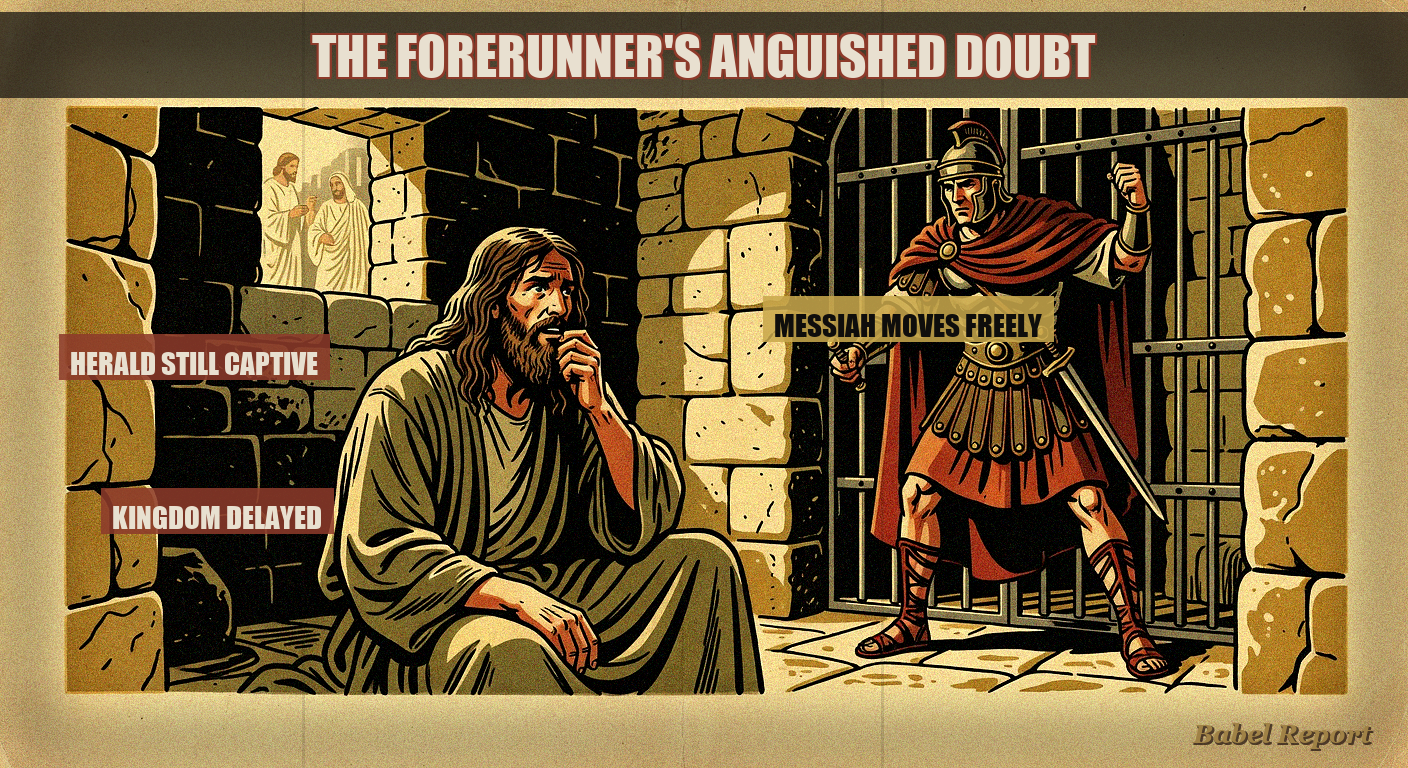
John's imprisonment created the perfect storm for doubt. Here was the forerunner of the Messiah, the greatest prophet born of woman according to Jesus himself, languishing in Herod's dungeon while his proclaimed Messiah moved freely through Galilee. If Jesus was truly the one who would bring the kingdom, why was his herald suffering under the very political oppression the kingdom was supposed to end?
The irony was devastating. John had prepared the way for the one who would set captives free, yet John remained captive. He had proclaimed the one who would bring down the mighty from their thrones, yet Herod still ruled from his palace while John rotted in prison. He had baptized the one who would baptize with the Holy Spirit and fire, yet the fire of judgment seemed to have been delayed indefinitely.
This was not merely personal frustration but theological crisis. John's continued imprisonment raised fundamental questions about the nature and timing of the kingdom. If God's reign was truly breaking into history through Jesus, why did the most obvious injustices remain unaddressed? Why did the righteous suffer while the wicked prospered? Why did political oppression continue unchecked?
From inside prison walls, John could hear reports of Jesus' ministry, but what he heard did not align with what he expected. Yes, there were healings and exorcisms. Yes, crowds were gathering. Yes, religious authorities were being challenged. But where was the ax laid to the root of the trees? Where was the winnowing fork separating wheat from chaff? Where was the fire that would consume the unrepentant?
"Are You the One Who Is to Come?"
John's question was not born of weak faith but of honest intellectual struggle with unexpectedly fulfilled prophecy. The phrase "the one who is to come" was loaded with messianic significance. It referred to the figure prophesied throughout Hebrew Scripture who would bring God's final salvation to his people. John was not asking whether Jesus was a good teacher or even a prophet. He was asking whether Jesus was the climactic figure of history itself.
The question reveals the depth of John's theological sophistication. He was not simply wondering whether he had made a mistake in identifying Jesus. He was wrestling with whether the entire framework within which he had understood God's promises needed revision. If Jesus was indeed the Messiah, then perhaps the Messiah's mission was different from what anyone had imagined. If the kingdom was truly arriving, then perhaps it was arriving in ways that transcended traditional categories.
This was the kind of question that could only come from someone who took Scripture seriously enough to be troubled by apparent contradictions. Lesser minds might have simply dismissed Jesus when his ministry failed to conform to expectations. John was too thoughtful for such easy answers. He knew that his own calling was bound up with Jesus' identity. If he had misunderstood Jesus, he had misunderstood his entire prophetic mission.
The timing of the question was crucial. John sent his disciples while Jesus was in the midst of his healing ministry but before the crucifixion and resurrection that would provide the key to understanding everything. John was trying to interpret an unfinished story with categories derived from earlier chapters. No wonder he found it puzzling.
Jesus' Response Strategy
Jesus' response to John's messengers was masterful in its indirection. Instead of providing a simple yes or no answer, he directed them to observe and report: "Go and tell John what you hear and see: the blind receive their sight and the lame walk, lepers are cleansed and the deaf hear, and the dead are raised up, and the poor have good news preached to them."
This response was brilliant precisely because it forced John to do his own theological work. Jesus was saying, in effect: "Look at what is actually happening and decide for yourself whether this fits the biblical pattern of God's salvation." He was pointing John back to Isaiah's prophecies about what would happen when YHWH returned to save his people, but he was letting John draw his own conclusions about how those prophecies were being fulfilled.
The list Jesus provided was not random but carefully constructed to echo specific passages from Isaiah that John would have known by heart. "Then the eyes of the blind shall be opened, and the ears of the deaf unstopped; then shall the lame man leap like a deer, and the tongue of the mute sing for joy... He has sent me to bring good news to the oppressed, to bind up the brokenhearted, to proclaim liberty to the captives."
But Jesus added one crucial element that was not in Isaiah's original prophecy: "Blessed is the one who is not offended by me." This gentle warning acknowledged that Jesus' way of fulfilling prophecy might be stumbling block even for the most faithful. John's difficulty was not failure of faith but evidence of how radically Jesus was redefining the categories through which God's salvation would come.
Resurrection as Ultimate Exile-Ending
Beyond National Restoration
The key that John could not yet possess was resurrection. From his prison cell, John could observe Jesus' healing ministry and wonder whether it was sufficient evidence of messianic identity. He could not yet see how the story would end – with the Messiah's death and victory over death itself. Without that final piece, the entire puzzle remained unsolved.
Resurrection was the ultimate exile-ending because it addressed the deepest level at which creation had been subjected to futility. Death was not merely the termination of individual lives but the symbol and consequence of cosmic disorder. As long as death reigned, the curse remained in effect. As long as the grave held its prisoners, exile from God's presence continued.
When Jesus rose from the dead, he broke the power that held all creation in bondage. This was not merely individual vindication (though it was that) or even proof of divine approval for his ministry (though it was that too). This was the decisive defeat of the enemies that no human army could conquer: sin and death and the devil himself. This was the moment when exile truly ended, not just for Israel but for the entire cosmos.
The resurrection revealed retrospectively what Jesus had been doing throughout his ministry. Every healing was a preview of creation's ultimate restoration. Every exorcism was a foretaste of Satan's final defeat. Every act of forgiveness was an anticipation of the moment when God would remember sin no more. The resurrection was not the beginning of something new but the completion of something that had been in progress all along.
This is why Paul could later write that if Christ has not been raised, then Christians are of all people most to be pitied. Without resurrection, Jesus' ministry remains enigmatic at best, fraudulent at worst. With resurrection, everything falls into place. The healings were not random acts of compassion but deliberate signs of the new creation breaking into the old. The kingdom was not delayed but present in a way that transcended political categories.
The Victory Over Death
Here lies the heart of why Jesus' approach to exile-ending was so different from what John expected. Military conquest could change political circumstances, but it could not change the human condition. Temple restoration could provide means of grace, but it could not remove the barrier that sin created between God and humanity. Even the most successful revolution would still leave death as the final enemy, the ultimate proof that something remained fundamentally wrong with the world.
Jesus' victory over death through resurrection accomplished what no political liberation could achieve. It demonstrated that God's power was greater than the forces that hold creation in bondage. It proved that the new creation was not merely hoped-for future but present reality breaking into history. It showed that the kingdom was not primarily about who rules earthly governments but about whether God's life can triumph over the powers of destruction.
The resurrection also vindicated Jesus' entire approach to ministry. His focus on healing rather than military preparation, his inclusion of outcasts rather than exclusive nationalism, his teaching about love for enemies rather than hatred for oppressors – all of this made sense once it became clear that he was addressing a deeper problem than foreign occupation. He was dealing with the exile that made all other exiles inevitable.
This does not minimize the reality of political oppression or social injustice. Rather, it provides the only foundation upon which such problems can be ultimately resolved. Unless the human heart is changed, political revolutions simply create new forms of oppression. Unless the power of death is broken, all human achievements remain under the shadow of futility. The resurrection addresses the root so that the fruit can be permanently transformed.
Validating John's Mission
Far from making John's ministry irrelevant, Jesus' redefinition of exile-ending actually validated everything John had proclaimed. John was right that the kingdom was at hand. He was right that the Messiah was coming. He was right that judgment and salvation were both imminent. He was right that Israel's long night of waiting was almost over.
What John could not have anticipated was the scope of what God intended to accomplish. The kingdom was indeed at hand, but it was larger than anyone had imagined – encompassing not just Israel but all nations, not just this age but the age to come. The Messiah was indeed coming, but he was not merely David's son but God's own presence in human form. Judgment was indeed imminent, but it would fall on sin and death rather than simply on political enemies.
John's role as forerunner remained crucial precisely because someone needed to prepare Israel for YHWH's return, even if that return took unexpected form. Someone needed to call the people to repentance, even if the forgiveness offered exceeded what anyone thought possible. Someone needed to point beyond himself to the greater one coming after, even if that greater one would redefine greatness itself.
The tragedy of John's imprisonment becomes, in retrospect, part of the larger story of how God brings salvation through suffering. John's doubt in prison parallels Jesus' cry of abandonment on the cross. Both represent the darkness that precedes dawn, the confusion that precedes clarity, the death that precedes resurrection. John's question from prison was not failure but faithfulness – the faithfulness of honest wrestling with mystery too large for human categories.
The Word Made Flesh: God Reframing Redemption
YHWH Incarnate in Jesus
Here we arrive at the deepest level of why John's categories needed expansion. Jesus was not simply God's appointed agent or even God's adopted son. He was the Word made flesh, the one in whom the fullness of deity was pleased to dwell bodily. This was God (YHWH) personally present in human history, not merely working through human instruments but taking human nature into the divine life itself.
This changes everything about how we understand exile and restoration. If Jesus is indeed YHWH incarnate, then his presence among his people is literally the return of God's glory to Israel that the prophets had promised. The Temple-in-person has come to dwell among us. The glory that departed from Solomon's Temple and never returned to Zerubbabel's has appeared in human form, tabernacling in our midst.
This incarnational understanding explains why Jesus could redefine the categories of kingdom and redemption with such authority. He was not merely interpreting God's will or even perfectly obeying God's commands. He was God's will in action, God's character embodied, God's love made visible. When he healed the sick, it was not just compassionate human action but divine power restoring creation. When he forgave sins, it was not just prophetic proclamation but divine prerogative exercised.
The incarnation also explains why the resurrection was necessary and sufficient to end exile definitively. If Jesus was merely human, his death would have been tragic defeat and his claimed resurrection would be irrelevant to anyone else's condition. But if Jesus was God incarnate, then his death represents God's willingness to enter fully into the human experience of alienation and abandonment, while his resurrection represents God's power to transform that experience from within.
Individual and Cosmic Unity
This brings us to the brilliant coherence of what Jesus accomplished. He addressed both the individual and cosmic dimensions of exile simultaneously because in him they were united. As perfect human being, he experienced the full weight of human alienation from God. As eternal Word, he possessed the divine power to overcome that alienation definitively.
The healings were not separate from the cosmic redemption but integral to it. When Jesus restored sight to blind eyes, he was demonstrating that the new creation affects real people in real circumstances. When he raised the dead, he was proving that God's victory over death is not merely spiritual metaphor but physical reality. The kingdom is both personal and political, individual and cosmic, present and future, because the one who brings the kingdom unites all these dimensions in his own person.
This is why John's doubt, though understandable, was ultimately unnecessary. Jesus was indeed the one who was to come – not despite the unexpected form his ministry took but precisely because of it. The healings were sufficient evidence of messianic identity because they demonstrated divine power at work to restore creation itself. The delay in political liberation was not failure of the kingdom but evidence of its greater scope.
John's question from prison thus becomes a window into the most profound theological transition in history. It shows us what it looked like to live through the moment when God's purposes, hidden from ages and generations, were finally revealed. It demonstrates the intellectual and spiritual challenge of recognizing the fulfillment of prophecy when that fulfillment transcends the categories through which the prophecy was originally understood.
The story of John's doubt is ultimately the story of how God's redemption is both smaller and larger than human expectations – smaller because it begins with one person in an obscure province of the Roman Empire, larger because it addresses the cosmic problem of sin and death that affects every created thing. John lived to witness the transition between the old age of waiting and the new age of fulfillment, between exile as political oppression and exile as cosmic disorder, between kingdom as national restoration and kingdom as new creation.
In a world still wrestling with the tension between political liberation and spiritual redemption, between individual healing and social transformation, between present suffering and future hope, John's question remains remarkably relevant. His doubt does not undermine his prophetic calling but validates it, showing us what faithful questioning looks like when faced with the mystery of God's unexpected ways. And Jesus' response remains the same: look at what is actually happening and decide for yourself whether the blind receiving sight and the dead being raised and the poor having good news preached to them might be evidence that the one who was to come has indeed arrived, even if he came in ways no one anticipated.
Perhaps that is precisely the story our own age needs to hear, that God's redemption is both more personal and more cosmic than our political categories can contain, and that the resurrection addresses a deeper exile than any human revolution could touch.


