
We live in an age fascinated by return narratives. Politicians promise to restore lost greatness. Religious movements dream of reclaiming ancient territories. Even secular movements speak of getting back to some imagined golden age before everything went wrong. It's a powerful story that cuts across cultures and ideologies: the people were at home, they were driven out, but someday they'll return and everything will be as it should be.
The Babylonian Exile has been read through this same lens for generations. The standard account goes something like this: the Jewish people were living faithfully in the promised land, they were punished with deportation to Babylon for their sins, and then under Cyrus they returned home to rebuild temple and society. Crisis, judgment, restoration. A tidy three-act drama that fits our instinct for stories with clear beginnings and endings.
But what if the most significant thing about the Babylonian Exile wasn't the deportation or even the return, but the permanent theological revolution it set in motion? What if diaspora became not a temporary crisis but a normative condition that fundamentally rewired Jewish consciousness and, through Paul, shaped Christian theology in ways we're only beginning to understand?
The evidence suggests something far more radical than the restoration narrative allows. The exile didn't just relocate bodies; it transformed minds. And once that transformation took hold, there was no going back, not even when Cyrus opened the doors and invited the exiles home.
Babylon's Theological Revolution: When Exile Became Normative
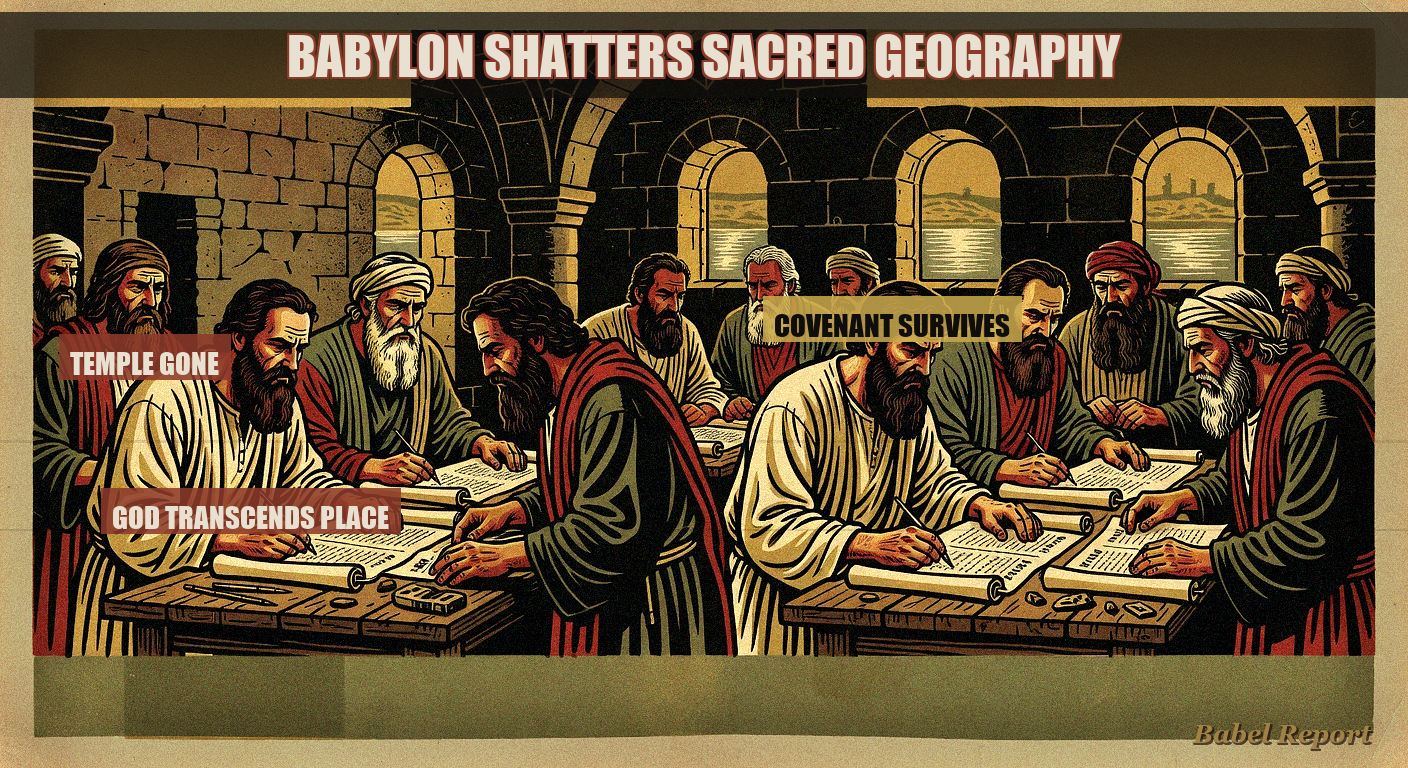
The Deportation That Rewired Jewish Consciousness
When Nebuchadnezzar's armies marched the Jewish elite eastward in 586 BCE, they weren't just changing geography. They were shattering a theological world. For centuries, Jewish faith had been inseparable from land, temple, and the immediate presence of God (YHWH), whom the Hebrews worshipped as their only alohim (God). The covenant promises were territorial. The sacrificial system was localized. Divine presence was mediated through specific places and particular priests.
Babylon changed everything.
Suddenly, the people of the covenant found themselves cut off from every mechanism through which they had known their God. No temple. No sacrifice. No holy city. The question wasn't just practical, how do we maintain identity in a foreign land? But theological: where is the Lord (YHWH) now?
The answer they discovered was revolutionary. God wasn't trapped in Jerusalem's ruins. Divine presence wasn't limited to temple precincts. The covenant wasn't void simply because the land was lost. Instead, exile became the laboratory where Jewish theology learned to find the sacred in displacement itself.
This wasn't merely adaptation; it was transformation. The exilic community discovered that their relationship with God didn't depend on geography but on something far more portable: memory, hope, and the conviction that absence could be as revelatory as presence.
The Literature of Permanent Displacement
The literary output of exilic and post-exilic Judaism reveals something remarkable: rather than treating exile as an unfortunate interruption, these texts began to normalize spiritual displacement as the authentic human condition.
Consider the book of Daniel. Written during or after the Babylonian period, Daniel doesn't present exile as something to overcome quickly but as the context within which faithfulness is tested and refined. Daniel and his companions don't spend their energy plotting return; they spend it learning to live faithfully as exiles. The visions don't promise immediate restoration but cosmic transformation that transcends geographical categories entirely.
The wisdom literature of this period follows a similar pattern. Books like Ecclesiastes and later wisdom texts operate with a profound sense that this world, any world, is not our permanent home. The righteous suffer. The wicked prosper. Justice is delayed. The wise response isn't to demand immediate resolution but to learn the art of faithful waiting.
This literature wasn't teaching resignation; it was teaching a new way of being religious. Exile wasn't the problem to be solved but the human condition to be embraced. Spiritual homelessness wasn't evidence of divine abandonment but the very context in which divine presence could be most authentically experienced.
The Hellenistic Acceleration of Diaspora Theology
When Jewish communities spread throughout the Mediterranean world under Hellenistic influence, they didn't simply maintain exilic theology – they accelerated it. Greek philosophical categories provided new vocabulary for what Babylon had already begun: the spiritualization of displacement.
Hellenistic Jewish writers like Philo developed sophisticated theologies that made the soul's exile from its true home not just a metaphor but a cosmological principle. The body was exile from the spiritual realm. This world was exile from the eternal realm. Physical displacement became a symbol for the universal human condition of separation from ultimate reality.
This wasn't Greek philosophy overwhelming Jewish faith; it was Jewish diaspora experience finding philosophical expression. The exile had already taught Judaism that presence and absence, home and displacement, could be held in creative tension. Hellenistic categories simply provided new tools for articulating what exile had made experientially real.
The result was a Judaism that could thrive anywhere precisely because it had learned to be at home nowhere. Diaspora wasn't the tragic result of historical accident; it was the theological advantage that allowed Jewish communities to flourish from Alexandria to Rome while maintaining their distinct identity.
And that's the point. By the time a young Pharisee named Saul encountered the resurrected Jesus (YHWShA) on the Damascus road, diaspora consciousness wasn't a new idea requiring invention. It was the theological inheritance of five centuries of Jewish thinking about presence, absence, and the location of the sacred.
The Return That Never Happened: Second Temple's Theological Exile
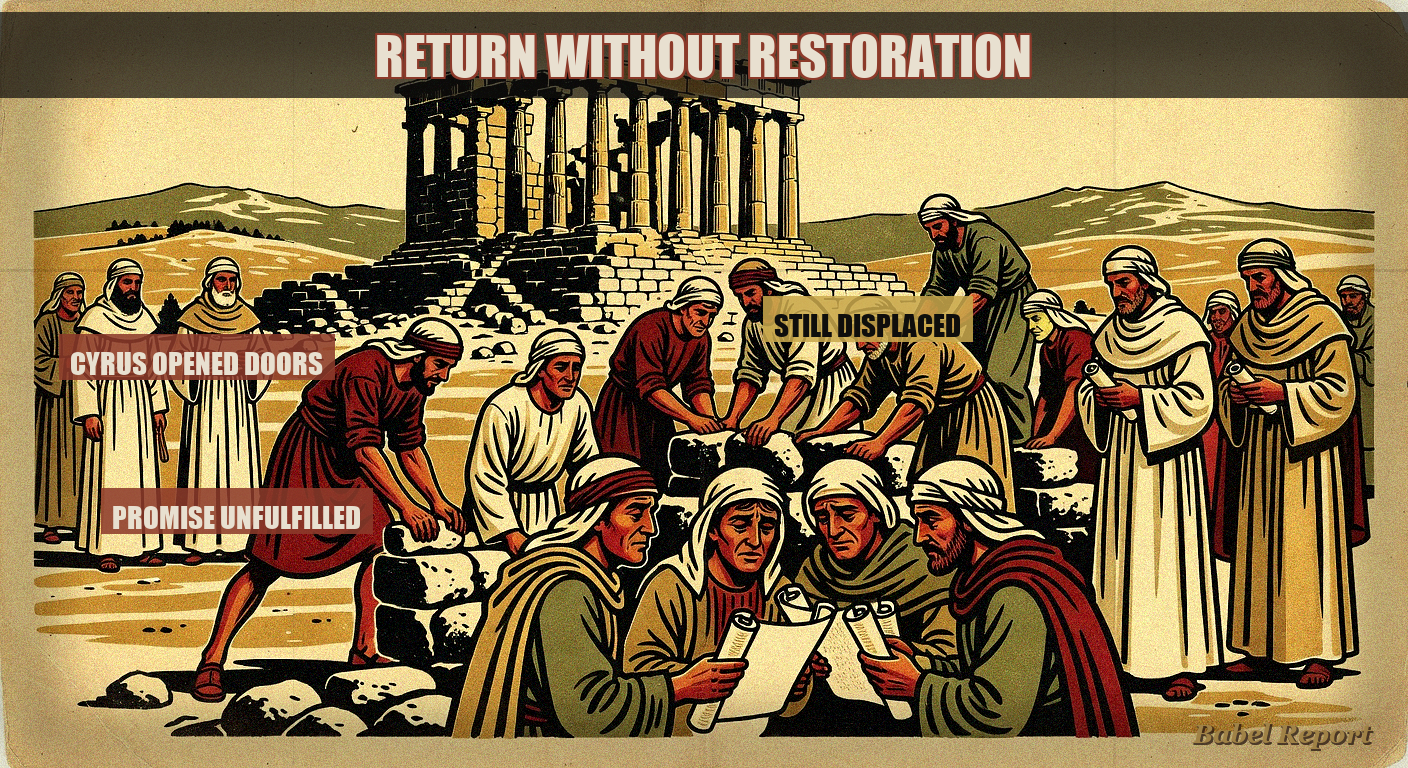
The Cyrus Decree and Its Theological Inadequacy
The standard narrative treats Cyrus's decree in 538 BCE as the end of the exile. The Persian emperor opened the doors, provided resources, and invited the Jewish communities to return home and rebuild their temple. Problem solved. Exile ended. Restoration achieved.
But the returning communities knew better.
Yes, some returned. Yes, they rebuilt the temple. Yes, they reestablished sacrificial worship. But anyone reading the literature of the Second Temple period with eyes unclouded by triumphalist assumptions can see that the theological consensus was clear: the real exile had never ended.
Where was the divine glory that had once filled Solomon's temple? Where was the Davidic king promised by the prophets? Where were the covenant blessings that should accompany true restoration? The Second Temple, however impressive, remained conspicuously empty of the divine presence that had once made the first temple the center of the world.
Ezra and Nehemiah chronicle communities wrestling with this theological crisis. They had returned to the land, but the land hadn't returned to Eden. They had rebuilt the temple, but God hadn't returned to the temple. The forms of restoration were present; the substance remained frustratingly absent.
Living Between Promise and Fulfillment
What emerged in Second Temple Judaism was a sophisticated theology of the "not-yet-home." Rather than declaring the exile over because geography had changed, these communities developed frameworks for living faithfully in the gap between promise and fulfillment.
The Psalms of Solomon, written in the first century BCE, capture this perfectly. The author writes of those who "are faithful in terrible times" and whose faithfulness will result in God sending a Messiah who would fulfill "at last the ancient dream." This wasn't the language of people who believed their exile was over. This was the language of people who had learned to make waiting sacred.
This theological development was crucial. It meant that Jewish identity no longer required successful possession of the promised land or effective control of religious institutions. Jewish identity could survive indeed, could flourish in the space between promise and fulfillment, in the tension between what had been promised and what had been received.
The genius of Second Temple Judaism wasn't its ability to restore the past but its capacity to sanctify the present precisely as incomplete. They discovered that unfulfillment could be as revelatory as fulfillment, that longing could be as sacred as satisfaction.
Here lies the insight that reshapes our understanding of Paul's later theological innovations. When Paul wrote to scattered Christian communities about living as strangers and exiles in this world, he wasn't inventing a new metaphor. He was drawing on centuries of Jewish reflection on what it means to be a people of promise in a world that remains stubbornly unredeemed.
Paul's Inheritance: Diaspora Consciousness as Apostolic Strategy
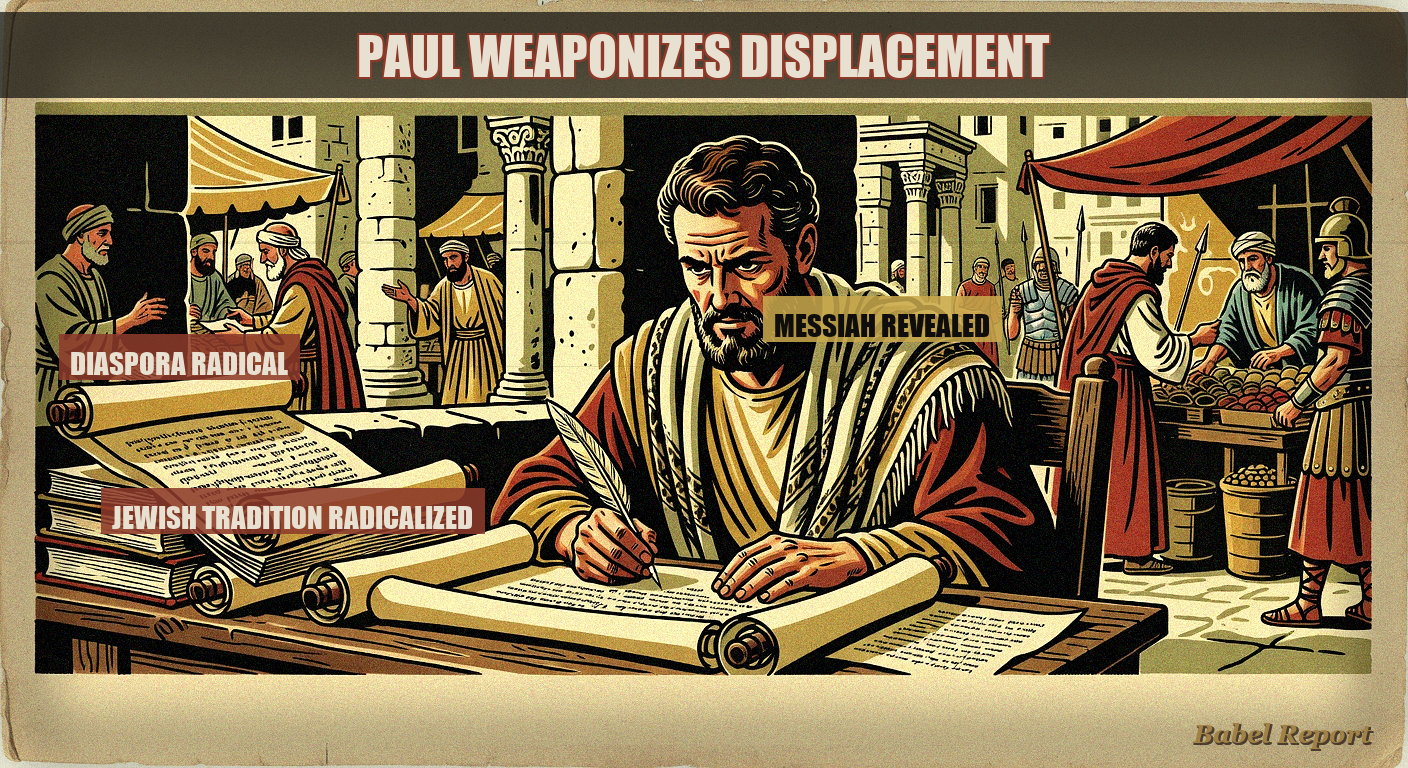
The Israelite Who Weaponized Displacement
Paul was always "a basically Jewish thinker" and "a Messiah-man" who recognized in the gospel events a new sort of revelation, the unveiling of Jesus as Messiah. But these "shocking, tradition-overturning, radically new events were the things that Israel's God had promised all along." Paul wasn't abandoning his Jewish heritage; he was radicalizing it.
The source of that radicalization was diaspora consciousness. Paul understood, as thoroughly as any Jew of his generation, that exile hadn't ended with Cyrus. He knew the theology of displacement that had sustained Jewish communities for centuries. He had inherited the intellectual framework that made spiritual homelessness not a problem to be solved but a condition to be embraced.
What Paul did was weaponize this inheritance. He believed that the "exile" had been brought to an end by Jesus' death on the cross. He believed that the postexilic covenant renewal had been launched in Jesus' resurrection and the gift of the Spirit. But here's the crucial insight: the end of exile didn't mean return to territorial normalcy. It meant the universalization of diaspora consciousness itself.
For Paul, Jesus' death and resurrection resolved the theological crisis of exile not by restoring the old arrangements but by making the exile condition sacred for everyone. The end of Israel's particular exile became the beginning of humanity's universal exodus toward the kingdom of God.
Universalizing the Exile Experience
This is where Paul's genius becomes clear. Rather than arguing that Christians had replaced Jews as God's people, Paul argued that Christians had joined Jews in the fundamental human condition: spiritual displacement from our ultimate home.
Paul is on common ground with his Jewish contemporaries in recognizing that Israel chose exile and death, that the prophets had warned this would happen, and that it did indeed happen. But Paul subverts the Jewish story from within. The end of this exile, and the real "return," are not future events to be experienced in terms of a cleansed Land, a rebuilt Temple, or an intensified Torah. The exile came to its cataclysmic end when Jesus, Israel's representative Messiah, died outside the walls of Jerusalem, bearing the curse of displacement itself.
This wasn't supersessionism in the traditional sense, Christians replacing Jews in God's favor. This was the universalization of diaspora theology. Paul was arguing that what Jews had experienced as their particular judgment and promise had now become the general human condition and opportunity.
Jews had learned in Babylon that God could be found in displacement. Paul argued that through Jesus, this displacement had become the normative spiritual condition for all humanity. We are all exiles now. We are all awaiting restoration. We all live between promise and fulfillment. And in that shared condition of not-yet-home, Jews and Gentiles discover their fundamental unity.
From Territory to Eschatology: The Great Theological Shift
Land-Based Hope Gives Way to Time-Based Promise
The theological revolution that began in Babylon and culminated in Paul's letters involved a fundamental shift in how divine promises were conceived. Traditional Jewish hope had been territorial: the land, the city, the temple. Diaspora Judaism learned to think temporally: the age to come, the resurrection, the kingdom.
This shift was what allowed Judaism to survive the destruction of the Second Temple in 70 CE. When the Romans burned Jerusalem, Jewish communities didn't collapse because they had already learned to locate their hope in time rather than place. The Babylonian exile had been the theological training that made survival possible when territorial hopes were shattered again.
Christianity inherited this same advantage. Paul's diaspora consciousness allowed the early church to spread without requiring control of any particular territory. Christian hope was eschatological rather than geographical. The kingdom of God wasn't a place to be conquered but a time to be awaited.
The practical implications were enormous. Jews could maintain their identity in Alexandria or Rome because Jewish hope no longer depended on controlling Jerusalem. Christians could establish communities in Corinth or Ephesus because Christian hope had never depended on controlling any earthly city.
The Advantage of Spiritual Displacement
What began as judgment had become opportunity. The exile that was once punishment had become the prerequisite for authentic religious life. Paul's theology made explicit what diaspora Judaism had discovered through experience: spiritual displacement wasn't something to overcome but something to embrace.
This is what made Paul's missionary strategy so effective. He wasn't asking Gentiles to become something they weren't – territorial Jews with claims on Palestinian land. He was inviting them to become what they already were: spiritual exiles awaiting their true home. The gospel didn't require Gentiles to adopt Jewish geography; it invited them to share Jewish eschatology.
The church, in Paul's vision, became the ultimate diaspora community. Not because Christians were physically scattered (though they often were) but because Christian identity was fundamentally eschatological. Christians were people whose citizenship was in heaven, whose true home was not yet revealed, whose deepest longing was for the restoration of all things.
This wasn't escapism. It was the theological framework that made engagement with the present world both possible and meaningful. Because Christians understood themselves as exiles, they could live faithfully in any political system without being co-opted by it. Because their hope was eschatological, they could work for justice in this age without being crushed when that justice remained incomplete.
The Church as Universalized Israel: Paul's Diaspora Vision
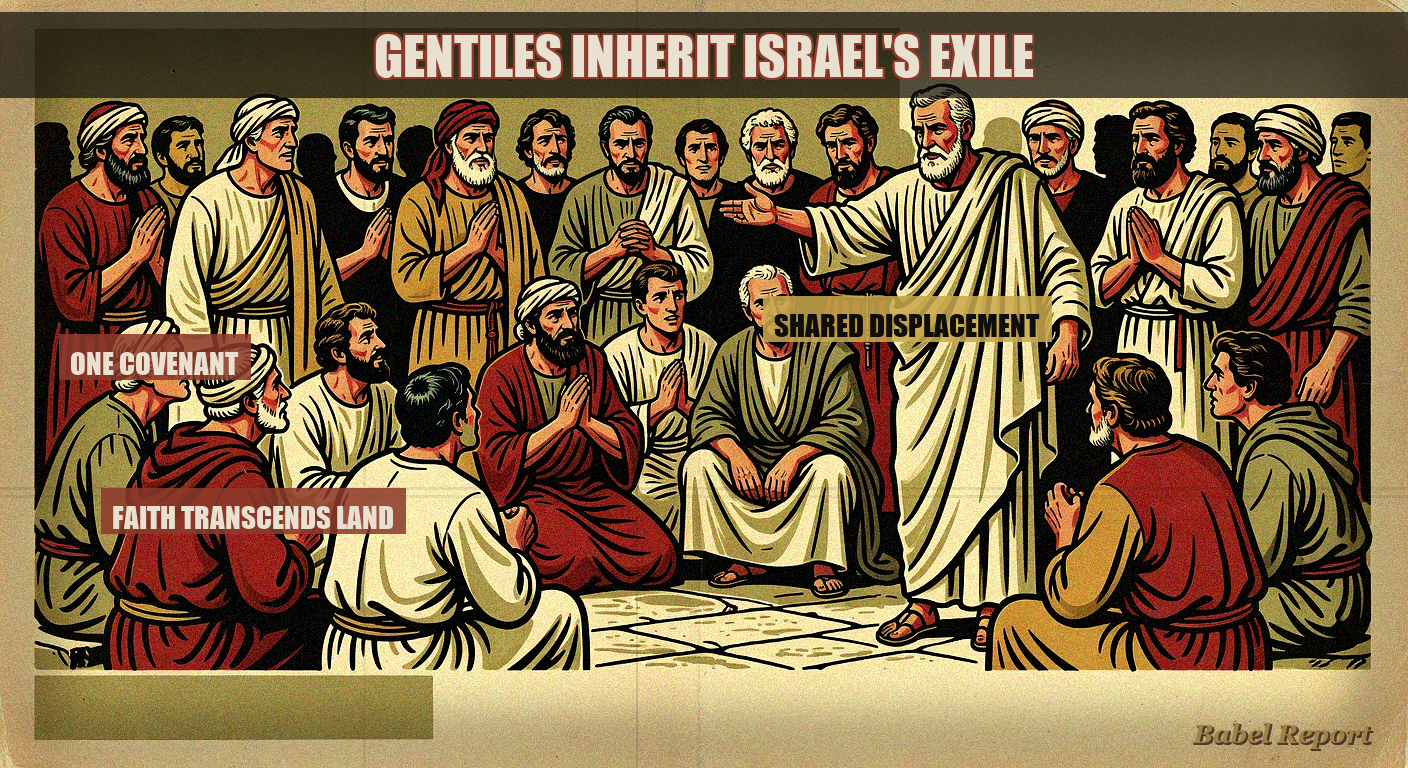
Inheriting Israel's Displacement
Paul's most radical theological move was arguing that the church had inherited not Israel's privileges but Israel's displacement. The Gentile Christians weren't replacing Jews; they were joining Jews in the fundamental human condition of spiritual exile that Babylon had first revealed and Jesus had universalized.
This inheritance wasn't about superseding the old covenant but about extending its deepest insights. Israel had learned in exile that God's presence wasn't limited by geography, that covenant relationship could survive without temple, that faithfulness could flourish in displacement. Paul argued that these lessons were never meant to remain Israel's exclusive possession.
Through Jesus, the theological advantages of exile became available to all nations. The diaspora consciousness that had sustained Jewish communities for centuries became the evangelistic framework through which the gospel could spread to every people group. Not because the gospel replaced Judaism but because the gospel universalized Judaism's hardest-won theological insights.
The church's identity as "strangers and exiles" wasn't metaphorical; it was the extension of Israel's actual historical experience to all who joined the people of God through Messiah. Christian communities weren't pretending to be displaced; they were embracing the displacement that had always been the human condition but which only exile had taught Israel to recognize and sanctify.
Eschatological Diaspora as Missionary Mandate
Paul's diaspora vision transformed Christian mission from territorial conquest to eschatological invitation. The gospel wasn't about establishing Christian kingdoms on earth but about calling all peoples to join the exodus toward the kingdom of heaven.
This framework made Christian mission both more humble and more universal than territorial models would allow. More humble because Christians weren't claiming to have arrived at their destination; they were inviting others to join them on the journey. More universal because the journey wasn't limited by ethnic or geographical boundaries; it was the common human pilgrimage toward restoration.
The missionary communities Paul established weren't outposts of Christian territory but diaspora communities modeling what it looked like to live faithfully in displacement. They were communities of the not-yet-home, sustained by hope rather than possession, defined by promise rather than achievement.
This is what made Paul's churches so resilient. They weren't dependent on political success or cultural dominance for their identity. Like the Jewish communities of the diaspora, they could maintain their distinctiveness while adapting to local circumstances because their fundamental identity wasn't tied to external arrangements but to eschatological hope.
The genius of Paul's diaspora theology was making permanent exile not a burden to be endured but an identity to be celebrated. The church wasn't waiting to get home; the church was home in the waiting itself. Not because displacement was pleasant but because displacement had become the context within which God's presence was most authentically known.
In Paul's hands, diaspora consciousness became the theological framework that made Christianity simultaneously Jewish and universal, rooted in particular history yet available to all nations, faithful to ancient promises yet radically innovative in their application. The exile that never ended became the gospel that would never end – the invitation to join God's people in their pilgrimage toward the restoration of all things.
This reframing challenges both Jewish and Christian triumphalism. Jews cannot claim that the exile ended with the return under Cyrus, because the theological revolution of diaspora consciousness made geographical restoration insufficient. Christians cannot claim to have superseded Jewish displacement, because Christian identity is fundamentally about sharing that displacement under the sign of Messiah.
What emerges is a more complex but ultimately more hopeful vision. The story that emerges isn't one of neat restoration but of permanent longing made sacred, a theological inheritance that shaped not just how we read Paul, but how we understand what it means to be a people of promise in a world that remains stubbornly unredeemed. The diaspora that began in Babylon and flowered in Paul's letters continues today in every community that finds its identity not in what it possesses but in what it awaits, not in the territories it controls but in the hope it carries.
And perhaps, in a world so fractured and uncertain, that is precisely the story we need, not the promise of return to some imagined golden age, but the invitation to find our home in the homelessness itself, sustained by the hope that displacement is not the end of the story but the very context in which God's presence becomes most real.


